My interest in genealogy, and in my own family history, stemmed from my family name: Laxague. I was always told that this name, pronounced differently by every unknowing substitute teacher who encountered its jumble of vowels and further confounding “x,” was Basque. So, I asked, what twists and turns led the name of my sheepherding, beret-sporting ancestors to adorn my pre-school report cards, bar mitzvah documents, and university diploma, thousands of miles from the ancestral “house by the river” in Euskal Herria? And, more simply, how the heck is it pronounced?
Basque immigration to what is now the United States pre-dated my grandfather’s journey from Les Aldudes to Los Angeles by many years. Although there is evidence that Basque whalers were some of the first Europeans to step foot in North America, the first waves of mass Basque migration occurred in the mid-19th century, when a combination of sociopolitical turmoil surrounding the Carlist Wars in Spain and the economic boom of the California Gold Rush enticed thousands of families to move to the American West. Though the fortunes of 49ers quickly dried up, Basque migration steamed ahead, primarily with farmers from agrarian Basque villages who ranched cattle and sheep in Northern California, Nevada, Idaho, and Oregon. Thus was the story of my ancestor, one John Laxague, whose simultaneously fascinating and harrowing fate weighs heavier on my mind. If you are curious about how Laxague is pronounced, I’m happy to dangle a carrot—or, more aptly, an Espelette pepper—and let you know at the end of this story.
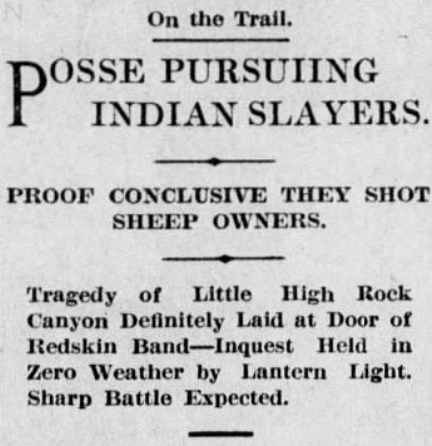
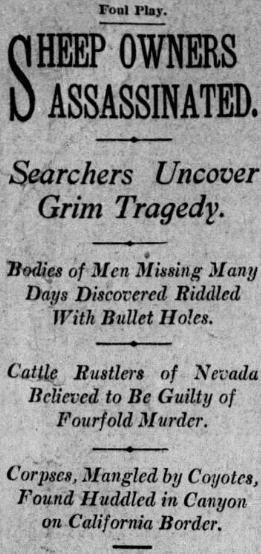
When research on my grandfather’s line brought me to California newspapers, a bevy of startling headlines lit up the search results. Though I hadn’t anticipated anything beyond want ads or city directory equivalents, I was instead met with “Foul Play: Sheep Owners Assassinated” and “Tragedy of Little High Rock Canyon Definitely Laid at Door of Redskin Band.” Using information from several local newspapers, I was able to put together the following timeline about John Laxague, a relative of my grandfather who immigrated from the neighboring Basque village.
Last seen leaving the Denio ranch on the Nevada-Oregon border on 19 January 1911 to check on their faraway herds of sheep, John Laxague and three others, part of “quite a few Basque sheepmen in Surprise Valley [at this time],” were missing for several weeks when alarm bells were raised.1 During a very snowy winter in the California-Nevada-Oregon tristate area, locals first feared they were overtaken by a storm or by well-known local cattle thieves. When their four bodies were eventually located on February 11, local newspapers from San Francisco, Los Angeles, and Carson City vividly illustrated the tragic scene.
In the following weeks, local fervor and bloodlust manifested itself in multiple “posses” set on avenging the Basque sheepmen. This regional hunt for revenge was well-documented in newspapers, and much information comes from a firsthand account of one of the posse members, Frank Vernon Perry. Rewards were offered to those who could avenge the deaths:
Nevada offered five thousand dollars, California one thousand dollars, Humphrey and Moffitt one thousands dollars, Mrs. John Erromouspe one thousand dollars, Mrs. John Laxague one thousand dollars. We were out to avenge the death of our friends and fellow men, not for reward money. We absolutely refused Mrs. Erromouspe's and Mrs. Laxague's offer, they lost enough.2
The incident garnered such attention to the point that the “Gov. of Nevada wired to President Taft asking for troops to assist in protecting the posse that is now searching for murderers, who are supposed to be Indians.” With the aid of California and Nevada State Police, much tracking of human and horse prints in the still-bountiful snow, and locals reporting sightings of the targeted group of Native Americans, Perry and company eventually found “Shoshone Mike” and his party.
The details of the following incident are haunting, and are summarized in depth in Perry’s firsthand account. Having never been to this region of northern Nevada nor neighboring Cedarville in California, the logistical play-by-play of Perry’s posse exacting revenge on Shoshone Mike and his party, though intriguing by its level of detail alone, is not what stuck with me upon learning this chapter of my family history. Instead, my prevailing emotional takeaway has been extreme discomfort, largely due to a combination of disturbing language surrounding Native Americans used in these historical records and my fledgling understanding of my family’s role in the eviction of peoples from their native lands.
Language is always changing and evolving, as is the public lexicon, so it is not surprising that terminology used in newspapers at the time may be uncomfortable to read to the modern historian. However, beyond evolutions in political correctness, I believe some of the language used in this account reflects public attitudes which can be hard to reckon with for anyone studying their family’s history. Did my relative John also subscribe to the notion that “a dead Indian is a good Indian,” as stated in a California newspaper, and that “rats breed lice, you should have killed them all,” like a community member said to Perry and the posse?3 Was killing eight Native Americans—double the initial total of murdered shepherds, including two women and two children—not seen as justice enough? Three further Native children were orphaned by the vengeful murders, another tragic outcome of this back-and-forth violence.
Certainly, John Laxague was not the first European immigrant to appropriate land that was formerly stewarded by Indigenous peoples, all too common in the context of global European colonialism. Its recency, however, exemplified by it being dubbed by the Nevada Historical Society Quarterly as “The Last Indian Uprising in the United States,” helps illustrate the relative recency of the decimation of Native American populations at the hands of European immigrants, which began over 400 years ago, and over 300 years before this episode took place.
My wishful understanding of my family’s trajectory in the United States always included Basque shepherds on my dad’s side and Jews fleeing persecution on my mom’s, naïvely hoping beyond hope that being a descendant of 20th-century immigrants meant I was not entangled with darker chapters of America’s past. Better understanding this piece of my family history, however, has shattered that conception and left me grappling with my modern responsibility to redress the crimes of my ancestors. Though John Laxague was undeniably the victim of a gruesome murder, the appalling violence perpetrated in his–and thus in our, in my–name makes me feel implicated in injustice from over a century ago. Studying family history is a beautiful, connecting practice which I very much enjoy doing for my own as well as others’ families. But, and perhaps more importantly, it also reflects how we today must continue acknowledging historical wrongs and strengthening our communities against such hate and violence.
Finally, for those of you who have only read thus far to learn how my name really is pronounced, well, it varies: I’ve always said “LOCK-sog” in English with the utmost confidence. However, upon living in France and visiting Pays Basque—where sheep are still tended on my family’s centuries-old farm—I learned it is more commonly “lack-SAG.” You’ll have to visit Les Aldudes to find out how it is pronounced in Basque; though it may sound different when emitted from a mouth full of sheep cheese.

Sources
1 Frank Vernon Perry, “The Last Indian Uprising in the United States,” Nevada Historical Society Quarterly 15.4 (1972):24.
2 Perry, “The Last Indian Uprising in the United States,” Nevada Historical Society Quarterly 15.4:31 ([Perry and others accepted reward money from the state of California]).
3 Perry, “The Last Indian Uprising in the United States,” Nevada Historical Society Quarterly 15.4:36.