---
title: "What Your Ancestors Ate: Historical Foods"
description: Explore the culinary traditions of your ancestors and discover historical recipes that connect us to the past, from cherry wine to 18th-century cookbooks.
image: https://vitabrevis.americanancestors.org/hubfs/historical%20food.png
---
# [Vita Brevis A resource for family history from AmericanAncestors.org](https://vitabrevis.americanancestors.org/)
This is a search field with an auto-suggest feature attached.
- There are no suggestions because the search field is empty.
# What Your Ancestors Ate: Historical Foods
[April 27, 2026](https://vitabrevis.americanancestors.org/what-your-ancestors-ate-historical-foods) [Object Lessons](https://vitabrevis.americanancestors.org/tag/object-lessons), [18th century](https://vitabrevis.americanancestors.org/tag/18th-century) [Kate Gilbert](https://vitabrevis.americanancestors.org/author/kgilbert)
There is a particular reason why historical reenactments and living history museums are so popular. They connect us with a time that is hard for us to imagine; therefore, we play it out so that we can see, feel, and listen to what our ancestors experienced. Some of our more popular living history museums in the Boston area include Plimoth Patuxet Museums, Old Sturbridge Village, and The Paul Revere House. Just north of us in Portsmouth, New Hampshire, the Strawbery Banke Museum features many remarkable buildings and homes along a waterfront neighborhood.
Whenever I visit these museums, I am always drawn to their food exhibits. I love to go into the historic homes with costumed interpreters and watch them cook in their hearth ovens. I love the smell of the fire and the food that surrounds and fills the homes, and it transports me to a time that I wish I could visit. When we research genealogy, we tend to focus on names and dates, but not on the individual personalities and practices of the time period in which we are researching. We don’t always consider the one building block of life that sustained our ancestors. Food is one avenue of research that can connect us to our ancestors - the simple thing that kept them alive.
While researching for a project a while back, I was searching page-by-page through a journal of Samuel Sewall, held at the Massachusetts Historical Society, when I found a recipe! Others may not have given the page a second glance, but I certainly did, already having a keen interest in historical foods! It is sometimes difficult to remember that these people that we research are just that: people. They recorded their daily activities, including what they ate and what they enjoyed. The entry was from May of 1718 and includes recipes for Cherry and Elderberry wine:1
*To Make Cherry Wine*
*Take six pounds of cherries three pounds of sugar and three quarts of water your cherries being stalked stoned and week broke, mix all together and put it into your cask. Let is be well shaked together every day for a week or ten days then stop it up very close and let it stand a quarter of a year and then you may bottle it. Weigh your cherries before they are stalked. *
*To Make Elderberry Wine*
*Take five quarts of Elderberry juice and three gallons of water and twelve pounds of good brown sugar mix them all well and boyl them together and scum it as long as any scum arises when it is almost cold work it with yeast a day or two and when it hath done working put it into a cask and in march when it is fine bottle it off after it is strained through a woolen bagg.*
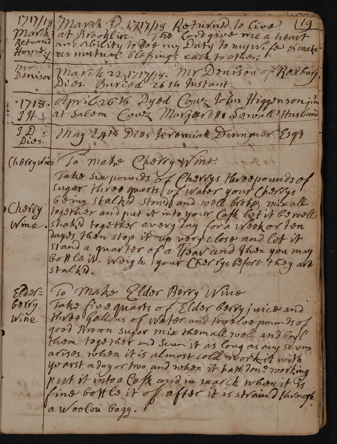
If you would like to see the entire journal yourself, there is a digital version available at the Massachusetts Historical Society. As a caveat and for clarification purposes, I do not recommend trying this recipe at home for yourself unless you are familiar with modern canning, sterilization, and brewing practices that were not available to the people of this time period. I am simply sharing this recipe as an example of how food was integrated into the lives of our ancestors.
To get a better understanding of 18th century foods and cookbooks, I typically turn to The Art of Cookery by Hannah Glasse, written in 1747, and American Cookery, written by Amelia Simmons in 1796. The Art of Cookery is considered foundational to the concept of modern cookbooks and was the most popular cookbook in 18th century England. She wrote this cookbook for the common man, and this was one of the first times that a cookbook was not created for royalty or even educated people. These are the types of recipes that our early ancestors would have cooked in the 18th century. Chapters include food for the sick, foods that are good for people who are going to sea, as well as numerous general cooking recipes. While this cookbook comes from England, American colonists needed to use the ingredients that were widely available to them, so they also adapted these types of recipes to fit their region as well. American Cookery is considered the first cookbook written by an American and was published in Connecticut in 1796. This cookbook incorporates regional ingredients and techniques available in America. It is a small cookbook, but includes ingredients such as chemical leavening, cranberries, pumpkin, corn, roast turkey, and corn meal.
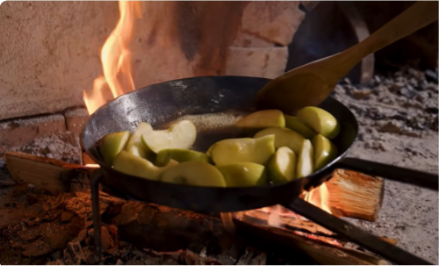
There is a fantastic website called [Townsends and Sons](https://www.townsends.us/), which is well known in the historical reenactment world for 18th century reproduction clothing. They also sell reprinted historical cookbooks on their website, including the two mentioned above. One of the modern books that they publish is called [Colonial Comfort Foods](https://www.townsends.us/collections/cookbooks/products/colonial-comfort-foods-by-michael-dragoo), by Michael Dragoo, which is a modern look at colonial food with recipes that are adapted for the modern kitchen. Additionally, they have a YouTube channel, [Townsends](https://www.youtube.com/@townsends), which features hundreds of videos that demonstrate cooking in the 18th century. It is a wonderful channel to watch if you are curious about this type of history! Below is a screenshot of one of the videos available on Townsends YouTube channel (the title is A Revolution In Cooking: 3 Recipes That Helped Hannah Glasse Change Everything) to give you an idea of what the channel is about. Can you smell the apples and the fire like I can? My mission is complete.
So, visit your living history museums, feel, smell, and experience the tastes of the 18th century, and connect with your ancestors in a different way! Enjoy!
[ ](https://vitabrevis.americanancestors.org/hs/cta/wi/redirect?encryptedPayload=AVxigLLiLV5Q0WKJWa835IMGNmp660bbTEOr%2B0cfrY1W1BK6Rm9xMZhAfnsCvBTYl4qAqsyr812HW45euvnvuNTR0ojNwlCAOeI0vnkoO09NQsdlqSR5Atwbor%2BMDu61Pz8VAi2zHtSMMpmmAHYyU5DTpxWHaaUSDsyaOInVxICQeb1uNko8zKB8nqw%3D&webInteractiveContentId=207187270804&portalId=4306738)
Sources
1. Massachusetts Historical Society, Samuel Sewall Papers, Miscellaneous manuscripts, 1675-1815, 171.3.24, 017.14, Arithmetick and Copy-book of Samuel Sewall, Jr., 1698-1772, image 256.
### Share this:
- [mailto:?body=https://vitabrevis.americanancestors.org/what-your-ancestors-ate-historical-foods](mailto:?body=https://vitabrevis.americanancestors.org/what-your-ancestors-ate-historical-foods)
-
-
- More
-
-

## About Kate Gilbert
Kate Gilbert has been a member of the Research Services team since 2023. She holds a BA in History from the University of New England, as well as a Master's Certificate in Museum Studies from Tufts University. She also obtained a Certificate in Genealogical Studies from Boston University, as well as a Certificate in Research and American Records from the International Institute of Genealogical Studies. Kate is also a Titanic Historian. She enjoys research in Ireland, and the New England states, and also has experience researching enslaved individuals, as well as research in the states of Minnesota, Pennsylvania, Georgia, New York, Kentucky, and research relating to locating living descendants. Areas of expertise: Ireland, French Canada, and New England[View all posts by Kate Gilbert →](https://vitabrevis.americanancestors.org/author/kgilbert)
[← One Family at a Time: My AAIHS Paper](https://vitabrevis.americanancestors.org/one-family-at-a-time-my-aaihs-paper)
[African American Intellectual History Society (AAIHS) Meeting →](https://vitabrevis.americanancestors.org/african-american-intellectual-history-society-aaihs-meeting)
This is a search field with an auto-suggest feature attached.
- There are no suggestions because the search field is empty.
### Recent Posts
[Sailor Bill and His Forgotten Wife](https://vitabrevis.americanancestors.org/sailor-bill-and-his-forgotten-wife)
[Professor X](https://vitabrevis.americanancestors.org/professor-x)
[Part I: Malaga Island, Maine](https://vitabrevis.americanancestors.org/part-i-malaga-island-maine)
[The Norwegian folge](https://vitabrevis.americanancestors.org/the-norwegian-folge)
[Research…in a Miniskirt? A ‘Style Guide’ to a Genealogist’s Wardrobe](https://vitabrevis.americanancestors.org/research-in-a-miniskirt-a-style-guide-to-a-genealogists-wardrobe)
### Archives
- [October 2014 (27)](https://vitabrevis.americanancestors.org/archive/2014/10)
- [December 2015 (24)](https://vitabrevis.americanancestors.org/archive/2015/12)
- [July 2020 (24)](https://vitabrevis.americanancestors.org/archive/2020/07)
- [April 2014 (23)](https://vitabrevis.americanancestors.org/archive/2014/04)
- [July 2014 (23)](https://vitabrevis.americanancestors.org/archive/2014/07)
- [December 2014 (23)](https://vitabrevis.americanancestors.org/archive/2014/12)
- [July 2015 (23)](https://vitabrevis.americanancestors.org/archive/2015/07)
- [March 2017 (23)](https://vitabrevis.americanancestors.org/archive/2017/03)
- [May 2017 (23)](https://vitabrevis.americanancestors.org/archive/2017/05)
- [August 2017 (23)](https://vitabrevis.americanancestors.org/archive/2017/08)
- [January 2018 (23)](https://vitabrevis.americanancestors.org/archive/2018/01)
- [March 2014 (22)](https://vitabrevis.americanancestors.org/archive/2014/03)
- [August 2014 (22)](https://vitabrevis.americanancestors.org/archive/2014/08)
- [April 2015 (22)](https://vitabrevis.americanancestors.org/archive/2015/04)
- [September 2015 (22)](https://vitabrevis.americanancestors.org/archive/2015/09)
- [October 2015 (22)](https://vitabrevis.americanancestors.org/archive/2015/10)
- [March 2016 (22)](https://vitabrevis.americanancestors.org/archive/2016/03)
- [June 2016 (22)](https://vitabrevis.americanancestors.org/archive/2016/06)
- [August 2016 (22)](https://vitabrevis.americanancestors.org/archive/2016/08)
- [September 2016 (22)](https://vitabrevis.americanancestors.org/archive/2016/09)
- [November 2016 (22)](https://vitabrevis.americanancestors.org/archive/2016/11)
- [December 2016 (22)](https://vitabrevis.americanancestors.org/archive/2016/12)
- [January 2017 (22)](https://vitabrevis.americanancestors.org/archive/2017/01)
- [June 2017 (22)](https://vitabrevis.americanancestors.org/archive/2017/06)
- [November 2017 (22)](https://vitabrevis.americanancestors.org/archive/2017/11)
### Categories
- [Family stories (1260)](https://vitabrevis.americanancestors.org/tag/family-stories)
- [American History (1137)](https://vitabrevis.americanancestors.org/tag/american-history)
- [Critical Analysis (1126)](https://vitabrevis.americanancestors.org/tag/critical-analysis)
- [Research Methods (881)](https://vitabrevis.americanancestors.org/tag/research-methods)
- [Brick Walls (674)](https://vitabrevis.americanancestors.org/tag/brick-walls)
- [Object Lessons (617)](https://vitabrevis.americanancestors.org/tag/object-lessons)
- [Spotlight (617)](https://vitabrevis.americanancestors.org/tag/spotlight)
- [Genealogical Writing (554)](https://vitabrevis.americanancestors.org/tag/genealogical-writing)
- [Research tips (510)](https://vitabrevis.americanancestors.org/tag/research-tips)
- [Serendipity (479)](https://vitabrevis.americanancestors.org/tag/serendipity)
- [Road Trips (393)](https://vitabrevis.americanancestors.org/tag/road-trips)
### Recent Posts
[Sailor Bill and His Forgotten Wife](https://vitabrevis.americanancestors.org/sailor-bill-and-his-forgotten-wife)
[Professor X](https://vitabrevis.americanancestors.org/professor-x)
[Part I: Malaga Island, Maine](https://vitabrevis.americanancestors.org/part-i-malaga-island-maine)
[The Norwegian folge](https://vitabrevis.americanancestors.org/the-norwegian-folge)
[Research…in a Miniskirt? A ‘Style Guide’ to a Genealogist’s Wardrobe](https://vitabrevis.americanancestors.org/research-in-a-miniskirt-a-style-guide-to-a-genealogists-wardrobe)
### Meta
- [Log in](https://vita-brevis.org/wp-login.php)
- [Entries RSS](https://vita-brevis.org/feed/)
- [Comments RSS](https://vita-brevis.org/comments/feed/)
- [WordPress.org](https://wordpress.org/)
### Subscribe to Blog via Email
Enter your email address to subscribe to this blog and receive notifications of new posts by email.
### Archives
- [October 2014 (27)](https://vitabrevis.americanancestors.org/archive/2014/10)
- [December 2015 (24)](https://vitabrevis.americanancestors.org/archive/2015/12)
- [July 2020 (24)](https://vitabrevis.americanancestors.org/archive/2020/07)
- [April 2014 (23)](https://vitabrevis.americanancestors.org/archive/2014/04)
- [July 2014 (23)](https://vitabrevis.americanancestors.org/archive/2014/07)
- [December 2014 (23)](https://vitabrevis.americanancestors.org/archive/2014/12)
- [July 2015 (23)](https://vitabrevis.americanancestors.org/archive/2015/07)
- [March 2017 (23)](https://vitabrevis.americanancestors.org/archive/2017/03)
- [May 2017 (23)](https://vitabrevis.americanancestors.org/archive/2017/05)
- [August 2017 (23)](https://vitabrevis.americanancestors.org/archive/2017/08)
- [January 2018 (23)](https://vitabrevis.americanancestors.org/archive/2018/01)
- [March 2014 (22)](https://vitabrevis.americanancestors.org/archive/2014/03)
- [August 2014 (22)](https://vitabrevis.americanancestors.org/archive/2014/08)
- [April 2015 (22)](https://vitabrevis.americanancestors.org/archive/2015/04)
- [September 2015 (22)](https://vitabrevis.americanancestors.org/archive/2015/09)
- [October 2015 (22)](https://vitabrevis.americanancestors.org/archive/2015/10)
- [March 2016 (22)](https://vitabrevis.americanancestors.org/archive/2016/03)
- [June 2016 (22)](https://vitabrevis.americanancestors.org/archive/2016/06)
- [August 2016 (22)](https://vitabrevis.americanancestors.org/archive/2016/08)
- [September 2016 (22)](https://vitabrevis.americanancestors.org/archive/2016/09)
- [November 2016 (22)](https://vitabrevis.americanancestors.org/archive/2016/11)
- [December 2016 (22)](https://vitabrevis.americanancestors.org/archive/2016/12)
- [January 2017 (22)](https://vitabrevis.americanancestors.org/archive/2017/01)
- [June 2017 (22)](https://vitabrevis.americanancestors.org/archive/2017/06)
- [November 2017 (22)](https://vitabrevis.americanancestors.org/archive/2017/11)