---
title: "One Family at a Time: My AAIHS Paper"
description: Explore how genealogy preserves Black history by connecting personal family stories to broader historical narratives and fostering community healing.
image: https://vitabrevis.americanancestors.org/hubfs/Probate%201.png
---
# [Vita Brevis A resource for family history from AmericanAncestors.org](https://vitabrevis.americanancestors.org/)
This is a search field with an auto-suggest feature attached.
- There are no suggestions because the search field is empty.
# One Family at a Time: My AAIHS Paper
[May 06, 2026](https://vitabrevis.americanancestors.org/one-family-at-a-time-my-aaihs-paper) [African American Research](https://vitabrevis.americanancestors.org/tag/african-american-research), [African American History](https://vitabrevis.americanancestors.org/tag/african-american-history) [Meaghan E.H. Siekman](https://vitabrevis.americanancestors.org/author/msiekman)
My paper for the AAIHS meeting had to contribute to an exciting atmosphere of deep intellectual thought amongst people who are also enthusiastic about demonstrating the importance of the past to the present. The theme of the entire conference was “Preserving Histories and Legacies in the 21st Century,” and my paper, “One Family at a Time: Using a Genealogists Toolbox to Preserve Black History,” aimed to discuss how genealogists are actively working to make connections across Black history in the United States.
My talk first focused on differentiating genealogy from history. The simplest answer may be that genealogists are working on a microhistory level – examining one family, often one person at a time. Part of this process is also being a good historian. Having an idea about what happened on a local, state, national, or even international stage during an ancestor’s lifetime not only breathes more life into their story, but it can also help you locate more records.
A historian may start their research with a historical moment and be concerned with other historical moments in how they relate to their primary research interest. Genealogists are almost always working backward in time from the present. Tracing one family often requires working in a bit of a back-and-forth motion through time to prove connections between generations. The primary research interest of the genealogist is the family line, which means that numerous periods of history and places may be moved through. Therefore, genealogists must also be comfortable not being experts in any one period or location and need to adapt to learning about new people and places frequently. We rely on historians to ground us in that knowledge.
Genealogists are extremely concerned about proof, so when a claim is made connecting generations, genealogists demand thorough documentation before accepting the line. This is particularly true of lineage societies that have standards of proof that must be met for membership. When there is doubt, genealogists provide as much information as was located and use words like “probably” or “likely” in hopes that other researchers may be able to locate new information before we will accept it as fact.
However much we are concerned about dates, documents, and proof, we are ultimately storytellers. Genealogists are confronting history on an extremely personal level, one where deep feelings reside. We have an ability to make history relevant and emotional for ordinary people because it is personal. We have a responsibility to both truth-telling and understanding human experience. As Ryan Woods, President and CEO of American Ancestors, once wrote to me: “there's genealogy as evidence-based reconstruction, and there is genealogy as human meaning-making.” A good genealogist is in the business of doing both.
I have begun to see genealogy as a tool for generational healing – the intentional process of identifying and breaking inherited, negative family patterns to prevent them from affecting future generations. On an individual family level, this might look like emotional, physical, or behavioral trauma, but these things exist on a community and population level. Genealogy hits all the levels to this process – it is personal to one family (traits and trauma handed down), but family existed within a community that was affected by even greater systems. Bringing to light and acknowledging the past on a personal level creates a touchstone for people that struggle to find the relevance of history in the trajectory of their lives.
So how is genealogy working to preserve Black history? Much of my own work involves researching enslaved ancestors. The greatest challenge in this work is the lack of documentation for enslaved people, particularly records that help connect generations. I must always use the FAN method (Friends, Associates, and Neighbors) to locate records for individuals. This often requires casting a large net, gathering and keeping track of many names. Typically, I end up mapping out entire neighborhoods or communities of people that were enslaved by the same people. This involves an exploration of the enslavers and their families as well. With each thread, the network of power becomes more evident and more tangible. The web also reveals deep connections among the enslaved or formerly enslaved that go deeper than biology – to chosen families and the determination of one generation to care for those younger than them, regardless of what the brutality of slavery did to their family units.
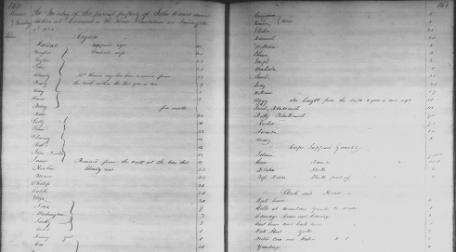*John Harris Probate, Albemarle County, Virginia, 1832*
I used examples from some of my own research to demonstrate how a project focused on one family can quickly expand to one including everyone enslaved on one plantation, or even in how plantations in one region all connected to each other. Specifically, a project tracing one family led to a project of mapping out eight plantations owned by John Harris in Albemarle County, Virginia when he died in 1832.[[i]](https://vitabrevis.americanancestors.org/one-family-at-a-time-my-aaihs-paper#_edn1) Reconstructing family units at these sites reveal lived experiences of people that the record tried to silence. Documenting these stories gifts them to the next generation who will not have to go searching for their ancestors. These are truly American stories, ones that require a deep knowledge of history and records, but also the human experience.
Genealogy is expanding who sees themselves in the American story, particularly for groups that have been traditionally excluded from archives. It is not merely a research method, but rather it is actively changing the way archives and collections work and serve their communities. Collections overlooked by other scholars are valuable to the Genealogist, and as genealogy’s popularity grows, archives shift which collections are digitized or made more public in other ways. Genealogists’ search for Black ancestors has also forced archives to consider what collections the seek out for their archives and reflect on whose stories they are preserving.
Genealogical databases and projects, like [10 Million Names](https://10millionnames.org/) at American Ancestors and the [GU272 Memory Project](https://gu272.americanancestors.org/), aim to make it easier for the public to access this history. These initiatives are not only valuable to the genealogists even as they are genealogically motivated. They reveal records and stories that can be incorporated into academic work or at public history institutions. Genealogy is a leader in the charge to broadcast silenced voices from the past and its methods are valuable to anyone interested in reconstructing the past.
[ ](https://vitabrevis.americanancestors.org/hs/cta/wi/redirect?encryptedPayload=AVxigLKQY5v0efaEApZvmGh6uLHc3UD8kbiGi2aB4OID%2B8NORlDCRr9GF%2BM55fYvkxIHY%2F5xc%2By3fqfE6zRg%2BspAUY2k0XCQ7M%2FoblaKNG7mZE1cinYkLk6dxUT0pinQC6hwAbeZVEJYpf6CWaLZO8khKA4MdsXiaJaq90KxO9inWQ%3D%3D&webInteractiveContentId=212319240531&portalId=4306738)
Sources
---
[[i]](https://vitabrevis.americanancestors.org/one-family-at-a-time-my-aaihs-paper#_ednref1) John Harris Probate Inventory, 1832, Albemarle County, Virginia Will Books 11:171-180.
### Share this:
- [mailto:?body=https://vitabrevis.americanancestors.org/one-family-at-a-time-my-aaihs-paper](mailto:?body=https://vitabrevis.americanancestors.org/one-family-at-a-time-my-aaihs-paper)
-
-
- More
-
-
## About Meaghan E.H. Siekman
Meaghan joined the American Ancestors staff in 2013 as a Researcher before moving to the Publications team in 2018 where she is currently a Senior Genealogist of the Newbury Street Press. As a part of the Publications team, Meaghan researches and writes family histories and other scholarly projects. She also regularly develops and presents lectures as well as other educational material on a variety of research topics. Additionally, Meaghan serves as the American Ancestor's representative to the New England Regional Fellowship Consortium. Meaghan holds a PhD in history from Arizona State University where her focus was public history and American Indigenous history. Prior to joining American Ancestors, she worked as Curator of the Fairbanks House in Dedham, Massachusetts and as an archivist at the Heard Museum Library in Phoenix. Meaghan also worked for the National Park Service and wrote several Cultural Landscape Inventories, most notably for Victoria Mine within the Organ Pipe Cactus National Monument. Her doctoral dissertation, Weaving a New Shared Authority: The Akwesasne Museum and Community Collaboration Preserving Cultural Heritage, 1970-2012, explored how tribal museum utilized shared authority with their communities. For American Ancestors, Meaghan authored Ancestry of Secretary Lonnie G. Bunch II in 2023, and Ancestry of Douglas Brinkley in 2019. She co-authored with Chistopher C. Child, Family Tales and Trials: Settling the American South in 2020. She also contributed to Ancestors of Cokie Boggs Roberts with Kyle Hurst in 2016. She has published portable genealogists on African American Genealogy (2015) and Native Nations in New England (2020). Meaghan has authored several articles in her tenure for American Ancestors magazine including most recently, “10 Myths about Slavery in the United States.” She has presented many lectures on African American genealogy, researching enslaved ancestors, researching the history of a house, using oral history in genealogical research, researching women, and other topics.[View all posts by Meaghan E.H. Siekman →](https://vitabrevis.americanancestors.org/author/msiekman)
[← Limitations of Artificial Intelligence (AI) in Genealogical Research](https://vitabrevis.americanancestors.org/-ai-in-genealogical-research)
[What Your Ancestors Ate: Historical Foods →](https://vitabrevis.americanancestors.org/what-your-ancestors-ate-historical-foods)
This is a search field with an auto-suggest feature attached.
- There are no suggestions because the search field is empty.
### Recent Posts
[Sailor Bill and His Forgotten Wife](https://vitabrevis.americanancestors.org/sailor-bill-and-his-forgotten-wife)
[Professor X](https://vitabrevis.americanancestors.org/professor-x)
[Part I: Malaga Island, Maine](https://vitabrevis.americanancestors.org/part-i-malaga-island-maine)
[The Norwegian folge](https://vitabrevis.americanancestors.org/the-norwegian-folge)
[Research…in a Miniskirt? A ‘Style Guide’ to a Genealogist’s Wardrobe](https://vitabrevis.americanancestors.org/research-in-a-miniskirt-a-style-guide-to-a-genealogists-wardrobe)
### Archives
- [October 2014 (27)](https://vitabrevis.americanancestors.org/archive/2014/10)
- [December 2015 (24)](https://vitabrevis.americanancestors.org/archive/2015/12)
- [July 2020 (24)](https://vitabrevis.americanancestors.org/archive/2020/07)
- [April 2014 (23)](https://vitabrevis.americanancestors.org/archive/2014/04)
- [July 2014 (23)](https://vitabrevis.americanancestors.org/archive/2014/07)
- [December 2014 (23)](https://vitabrevis.americanancestors.org/archive/2014/12)
- [July 2015 (23)](https://vitabrevis.americanancestors.org/archive/2015/07)
- [March 2017 (23)](https://vitabrevis.americanancestors.org/archive/2017/03)
- [May 2017 (23)](https://vitabrevis.americanancestors.org/archive/2017/05)
- [August 2017 (23)](https://vitabrevis.americanancestors.org/archive/2017/08)
- [January 2018 (23)](https://vitabrevis.americanancestors.org/archive/2018/01)
- [March 2014 (22)](https://vitabrevis.americanancestors.org/archive/2014/03)
- [August 2014 (22)](https://vitabrevis.americanancestors.org/archive/2014/08)
- [April 2015 (22)](https://vitabrevis.americanancestors.org/archive/2015/04)
- [September 2015 (22)](https://vitabrevis.americanancestors.org/archive/2015/09)
- [October 2015 (22)](https://vitabrevis.americanancestors.org/archive/2015/10)
- [March 2016 (22)](https://vitabrevis.americanancestors.org/archive/2016/03)
- [June 2016 (22)](https://vitabrevis.americanancestors.org/archive/2016/06)
- [August 2016 (22)](https://vitabrevis.americanancestors.org/archive/2016/08)
- [September 2016 (22)](https://vitabrevis.americanancestors.org/archive/2016/09)
- [November 2016 (22)](https://vitabrevis.americanancestors.org/archive/2016/11)
- [December 2016 (22)](https://vitabrevis.americanancestors.org/archive/2016/12)
- [January 2017 (22)](https://vitabrevis.americanancestors.org/archive/2017/01)
- [June 2017 (22)](https://vitabrevis.americanancestors.org/archive/2017/06)
- [November 2017 (22)](https://vitabrevis.americanancestors.org/archive/2017/11)
### Categories
- [Family stories (1260)](https://vitabrevis.americanancestors.org/tag/family-stories)
- [American History (1137)](https://vitabrevis.americanancestors.org/tag/american-history)
- [Critical Analysis (1126)](https://vitabrevis.americanancestors.org/tag/critical-analysis)
- [Research Methods (881)](https://vitabrevis.americanancestors.org/tag/research-methods)
- [Brick Walls (674)](https://vitabrevis.americanancestors.org/tag/brick-walls)
- [Object Lessons (617)](https://vitabrevis.americanancestors.org/tag/object-lessons)
- [Spotlight (617)](https://vitabrevis.americanancestors.org/tag/spotlight)
- [Genealogical Writing (554)](https://vitabrevis.americanancestors.org/tag/genealogical-writing)
- [Research tips (510)](https://vitabrevis.americanancestors.org/tag/research-tips)
- [Serendipity (479)](https://vitabrevis.americanancestors.org/tag/serendipity)
- [Road Trips (393)](https://vitabrevis.americanancestors.org/tag/road-trips)
### Recent Posts
[Sailor Bill and His Forgotten Wife](https://vitabrevis.americanancestors.org/sailor-bill-and-his-forgotten-wife)
[Professor X](https://vitabrevis.americanancestors.org/professor-x)
[Part I: Malaga Island, Maine](https://vitabrevis.americanancestors.org/part-i-malaga-island-maine)
[The Norwegian folge](https://vitabrevis.americanancestors.org/the-norwegian-folge)
[Research…in a Miniskirt? A ‘Style Guide’ to a Genealogist’s Wardrobe](https://vitabrevis.americanancestors.org/research-in-a-miniskirt-a-style-guide-to-a-genealogists-wardrobe)
### Meta
- [Log in](https://vita-brevis.org/wp-login.php)
- [Entries RSS](https://vita-brevis.org/feed/)
- [Comments RSS](https://vita-brevis.org/comments/feed/)
- [WordPress.org](https://wordpress.org/)
### Subscribe to Blog via Email
Enter your email address to subscribe to this blog and receive notifications of new posts by email.
### Archives
- [October 2014 (27)](https://vitabrevis.americanancestors.org/archive/2014/10)
- [December 2015 (24)](https://vitabrevis.americanancestors.org/archive/2015/12)
- [July 2020 (24)](https://vitabrevis.americanancestors.org/archive/2020/07)
- [April 2014 (23)](https://vitabrevis.americanancestors.org/archive/2014/04)
- [July 2014 (23)](https://vitabrevis.americanancestors.org/archive/2014/07)
- [December 2014 (23)](https://vitabrevis.americanancestors.org/archive/2014/12)
- [July 2015 (23)](https://vitabrevis.americanancestors.org/archive/2015/07)
- [March 2017 (23)](https://vitabrevis.americanancestors.org/archive/2017/03)
- [May 2017 (23)](https://vitabrevis.americanancestors.org/archive/2017/05)
- [August 2017 (23)](https://vitabrevis.americanancestors.org/archive/2017/08)
- [January 2018 (23)](https://vitabrevis.americanancestors.org/archive/2018/01)
- [March 2014 (22)](https://vitabrevis.americanancestors.org/archive/2014/03)
- [August 2014 (22)](https://vitabrevis.americanancestors.org/archive/2014/08)
- [April 2015 (22)](https://vitabrevis.americanancestors.org/archive/2015/04)
- [September 2015 (22)](https://vitabrevis.americanancestors.org/archive/2015/09)
- [October 2015 (22)](https://vitabrevis.americanancestors.org/archive/2015/10)
- [March 2016 (22)](https://vitabrevis.americanancestors.org/archive/2016/03)
- [June 2016 (22)](https://vitabrevis.americanancestors.org/archive/2016/06)
- [August 2016 (22)](https://vitabrevis.americanancestors.org/archive/2016/08)
- [September 2016 (22)](https://vitabrevis.americanancestors.org/archive/2016/09)
- [November 2016 (22)](https://vitabrevis.americanancestors.org/archive/2016/11)
- [December 2016 (22)](https://vitabrevis.americanancestors.org/archive/2016/12)
- [January 2017 (22)](https://vitabrevis.americanancestors.org/archive/2017/01)
- [June 2017 (22)](https://vitabrevis.americanancestors.org/archive/2017/06)
- [November 2017 (22)](https://vitabrevis.americanancestors.org/archive/2017/11)