Researching the lives of enslaved people in colonial New England presents significant methodological challenges. Surviving records are sparse, inconsistent, and were typically created to serve the needs of enslavers, not to preserve the identities or lives of the enslaved themselves. In many cases, an individual appears in the historical record only once, with minimal identifying details. The case of Pegge, an enslaved Indigenous girl connected to Boston merchant Benjamin Gibbs in the 1670s, demonstrates both the possibilities and limitations of reconstructing such histories.
The starting point for this research is the account book of John Hull, a prominent Boston merchant and mintmaster.1 Within Hull’s ledger there are numerous transactions involving the sale and purchase of enslaved Indigenous people. The format of these entries varies considerably. Some are detailed, listing individuals by name, age, and value; others simply record the number of enslaved people and the total price, with no identifying information.
These discrepancies raise interpretive questions: why are some transactions recorded in detail, while others are vague? The variation may reflect the size or nature of a transaction, the perceived importance of the individuals involved, or the recordkeeper’s own priorities. Whatever the cause, these differences complicate efforts to trace individuals across multiple sources.
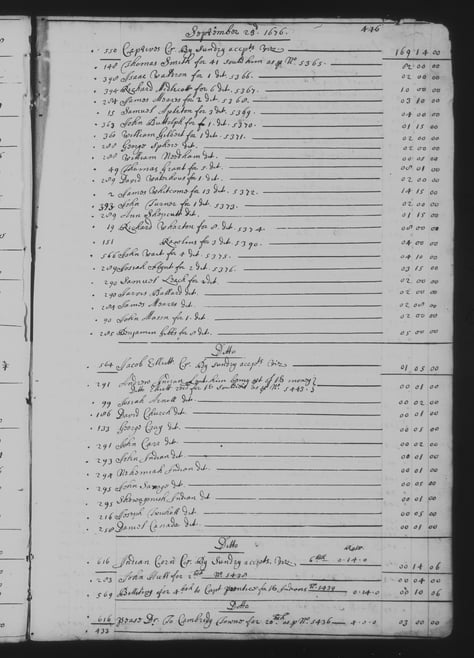
Two entries in Hull’s journal from 1676 illustrate this problem. The first, dated 24 August 1676, records the sale of enslaved Indigenous people with considerable detail, including names, ages, and individual valuations.2 The second, dated 23 September 1676, documents Benjamin Gibbs’s purchase of eight enslaved Indigenous people for 5 pounds, but does not provide names, ages, or genders.3
The contrast between these entries is not without explanation. August 1676 marked the end of King Philip’s War. Captives taken during the war were frequently sold into slavery. The September purchase involved a larger number of captives, prompting a less detailed record, while the August sales were smaller in scale. Furthermore, the war had just ended in August, resulting in the number of captives being much less than in September, when colonists could capture more Indigenous people.4 Regardless of the reason, the absence of detail in the September entry obscures the identities of the eight individuals involved.
A month later, on 29 October 1676, Gibbs executed a deed with his father-in-law, Joshua Scattow. The deed records that Gibbs owed Scattow 190 pounds and had two years to repay the debt. As collateral, Gibbs pledged three enslaved Africans — Hector, Ferdinando, and Flora — and one enslaved Indigenous girl named Pegge.5 The proximity of this deed to Gibbs’s September purchase from Hull suggests that Pegge may have been one of the eight enslaved people acquired in that transaction. While this is a reasonable hypothesis, the absence of explicit confirmation means the identification remains tentative.
When Benjamin Gibbs died in 1678, John Hull, named executor in the will, renounced his role, and administration was granted to Gibbs’s widow Lydia. The will itself provided Lydia with the use and possession of “all and singular my personall and Reall Estate during the time of her widdowhood,” including the mansion house for her lifetime. To his daughter Lydia, he left 500 pounds and furnishings, and he further provided 300 pounds should a second child be born alive. Lydia also received authority to dispose of 200 pounds at her death, along with the use of half of the estate during her life. The mansion house was entailed to Gibbs’s heirs by Lydia.6
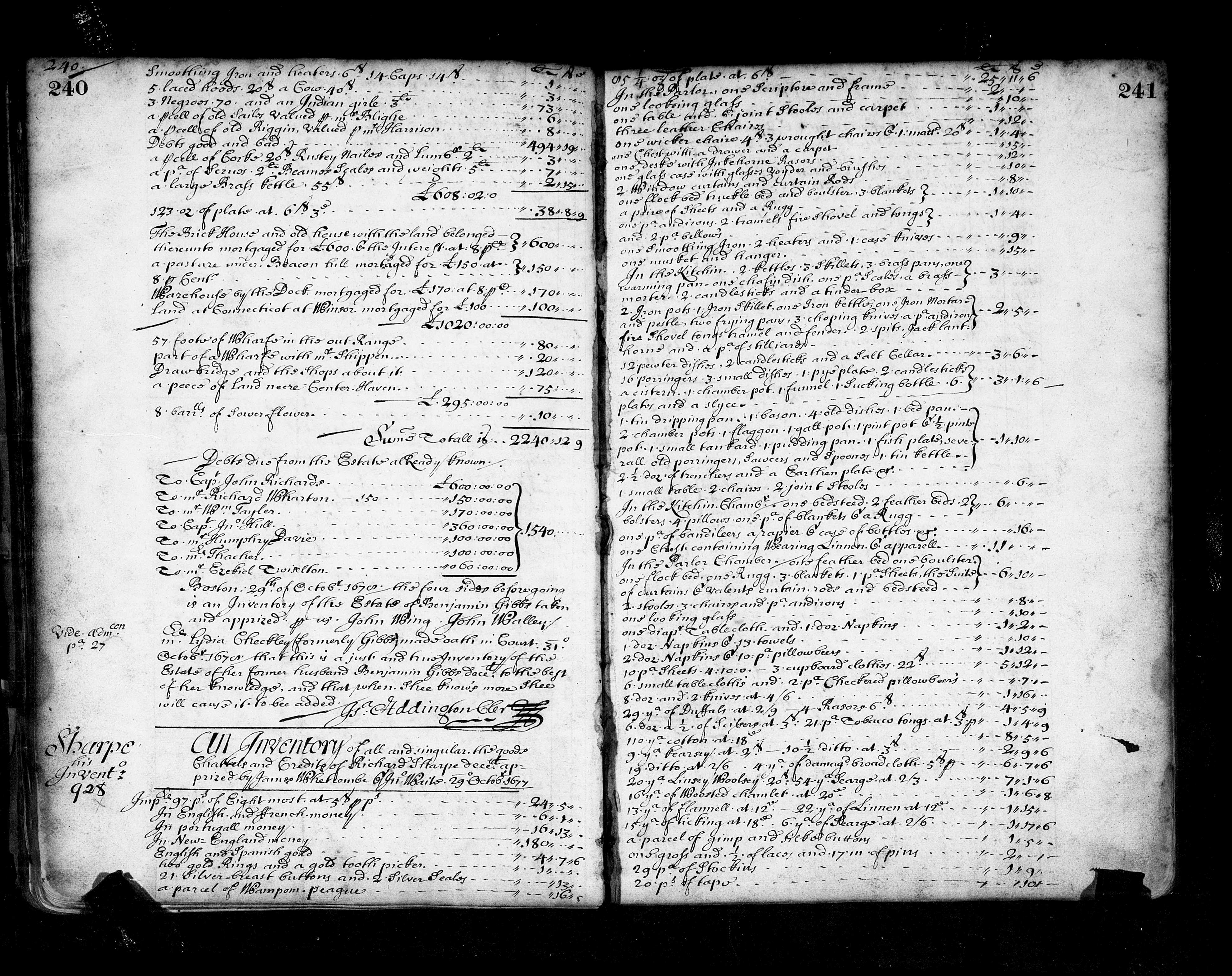
The estate inventory taken on 29 October 1678 listed three “negroes” and one “Indian girl” valued collectively at 73 pounds, with the Indian girl individually appraised at 3 pounds. Because enslaved persons were part of the personal estate and not specifically assigned in the will, they would have fallen under Lydia’s control during her widowhood. Thus, the “Indian girl,” likely Pegge, most plausibly remained with Lydia until her remarriage. Lydia later married Anthony Checkley and then William Colman, but as no probate survives for Lydia, Pegge’s ultimate fate remains uncertain. The 3 pounds valuation, however, aligns with John Hull’s prices for Indigenous children in August 1676, which supports, though does not prove, the possibility that Pegge was the same “Indian girl” noted in the inventory and part of the September 1676 purchase.
In the absence of definitive identifying information, valuation can sometimes serve as a comparative tool for linking records. The 3-pound value assigned to the Indian girl in Gibbs’s inventory aligns closely with contemporary valuations for Indigenous children. However, valuations could vary depending on factors such as age, health, and perceived skills, and they were ultimately subjective assessments made by colonists. Thus, while valuation provides supporting evidence, it cannot establish identity with certainty.
Following Gibbs’s death, efforts to locate further records of Pegge produced one potential match. Boston’s vital records include an entry for a “negro” woman named Pegge who had a child, Jenne, with an enslaved man named Secundas. The spelling of “Pegge” in this record matches that in the 1676 deed.7
However, this possible connection is complicated by several factors. The vital record does not specify whether Pegge was African or Indigenous, and no direct link is made to Gibbs’s household. Given these uncertainties, it is impossible to determine whether the woman in the vital record is the same Pegge mentioned in the 1676 deed and 1678 inventory.
The case of Pegge underscores the broader challenges of researching enslaved individuals in colonial New England. Names, when recorded, may appear only once or be inconsistently spelled. Ages and other identifying details are frequently absent. Individuals may be described differently in separate records, and multiple people could share the same name within a relatively small geographic area.8
In this context, even when multiple records align in terms of name, valuation, and chronology, there remains the possibility of coincidence. The historical record rarely allows for absolute certainty in such identifications.
Was Pegge in the October 1676 deed the same person as the Indian girl in Gibbs’s 1678 inventory? The chronological proximity, consistent valuation, and the economic logic of Gibbs using recently purchased enslaved individuals as collateral suggest that this is plausible, even likely. Was she also one of the eight enslaved Indigenous people Gibbs bought from Hull in September 1676? The evidence supports this hypothesis but does not conclusively prove it.
As for the Pegge in Boston’s vital records, the connection is even more tenuous. While the matching spelling is notable, the lack of ethnic identification and absence of corroborating details regarding ownership makes the link speculative at best.
The most accurate conclusion is that the available evidence allows for reasonable inference on Pegge’s ownership and origins.
Despite the absence of definitive answers, the effort to reconstruct Pegge’s life has historical value. Each fragmentary reference, whether in a merchant’s account book, a deed, or a probate inventory, illuminates the presence of both African and Indigenous slavery in colonial Boston. Pegge’s appearance in the record is rare for an Indigenous enslaved person in this period and offers insight into the economic and social networks that facilitated slavery in New England.
This case also highlights the methodological importance of cross-referencing multiple types of sources, such as merchant records, legal documents, probate inventories, and vital records, to build as complete a picture as possible even when gaps remain. The limitations of the evidence are themselves part of the historical reality.
By piecing together what can be known, and acknowledging what cannot, historians can both recover fragments of individual lives and confront the systems that sought to erase them. Pegge’s story, incomplete as it is, stands as a reminder of the human cost embedded in the colonial record and the necessity of careful, critical analysis in recovering these histories.

Sources
[1] Account Books of John Hull, Mss 600, R. Stanton Avery Special Collections, New England Historic Genealogical Society.
[2] Account Books of John Hull, vol. 2, pg. 398, Mss 600, R. Stanton Avery Special Collections, New England Historic Genealogical Society.
[3] Account Books of John Hull, vol. 2, pg. 446, Mss 600, R. Stanton Avery Special Collections, New England Historic Genealogical Society.
[4] Basic Context and Timeline of Contextual Events of the Falls Fight of May 19, 1676, Compiled by the Montague Historical Commission and others, technical report, Pequot Museum and Research Center, Apr. 2016, Town of Montague, MA, PDF file. www.montague-ma.gov/files/Timeline_of_Events.pdf.
[5] Massachusetts, Land Records, 1620–1986. FamilySearch, Suffolk County, Deeds 1678–1683, vol. 11–12, image 182 of 999, County courthouses and offices, Massachusetts, Accessed 17 August 2025. www.familysearch.org/ark:/61903/3:1:3QS7-89ZS-196J?cc=2106411&wc=MCBL-B29%3A361613401%2C361837401.
[6] Suffolk County probate records, 1636–1899, FamilySearch, Suffolk County, Probate records 1636–1766, vol. 1–2, image 510 of 625, County courthouse and offices, Massachusetts, Accessed 17 August 2025. www.familysearch.org/ark:/61903/3:1:3Q9M-C9Y5-RBQR?view=explore.
[7] Boston (Mass.). Registry Dept., and First Church (Boston, Mass.), Boston Births, Baptisms, Marriages and Deaths, 1630–1699, Rockwell and Churchill, City Printers, 1883.
[8] Siekman, Meaghan E.H. “Slave Surnames.” Vita Brevis, 26 May 2021, https://vitabrevis.americanancestors.org/2021/05/slave-surnames