Michigan’s Keweenaw Peninsula is no stranger to tragedy. Every November, the haunting ballad “The Wreck of the Edmund Fitzgerald” by Gordan Lightfoot can be heard across radio stations throughout the region, commemorating the tragic loss of 29 lives aboard the SS Edmund Fitzgerald. On the night of 10 November 1975, the freighter sank during a storm in Lake Superior, near Whitefish Bay.
But there is another haunting, though less widely known, ballad that commemorates a different tragedy connected to the Keweenaw: Woody Guthrie’s “1913 Massacre,” which honors the 59 children and 14 adults who lost their lives in the Italian Hall Disaster on Christmas Eve 1913.
What was meant to be a night of holiday festivities for hardworking copper miners and their families—five months into a labor strike against the Calumet and Hecla Mining Company over concerns about pay and workplace safety—turned into a night of unimaginable tragedy.1
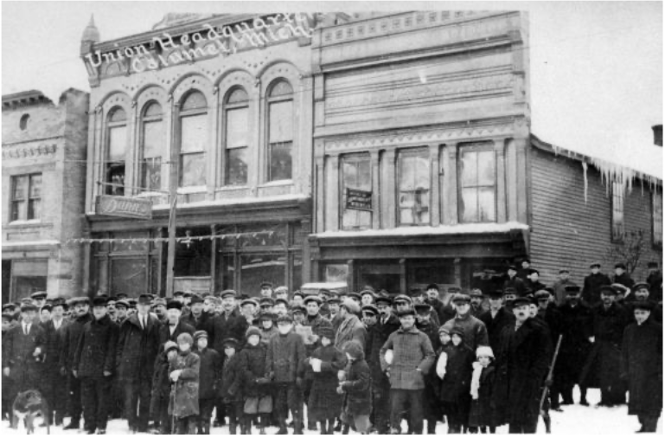
Miners and their families outside Union Headquarters in Calumet, Michigan. ca. 1913-1914, image courtesy of Walter P. Reuther Library
Many decades after the event, stories of that night and the sorrowful days that followed are still retold, perhaps a little differently depending on the perspective and political leanings of the source.
The Keweenaw National Historical Park, which honors those who lost their lives with 73 luminaries each year, emphasizes that we still do not know exactly what happened that night.2
Most accounts, however, do not dispute that someone falsely shouted “Fire!,” prompting a frantic stampede of men, women, and children down a deep, narrow stairwell toward a closed door that for whatever reason never opened.
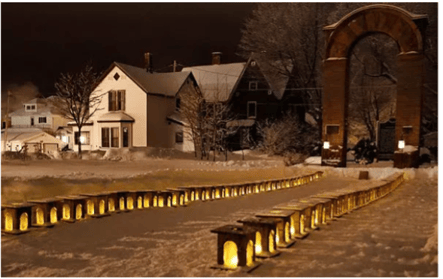 "Luminaires light the way to the Italian Hall memorial," image courtesy of the Keweenaw National Historical Park.
Guthrie’s song, written nearly forty years after the tragedy, offers a more critical interpretation, clearly reflecting the perspective of the striking miners. His lyrics claim that “copper-boss thug-men” shouted “Fire!” and then held the door to the Italian Hall shut, preventing the families inside from escaping:
Take a trip with me in 1913
To Calumet, Michigan, in the copper country
I'll take you to a place called Italian Hall
And the miners are having their big Christmas Ball
I'll take you in a door and up a high stairs
Singing and dancing is heard everywhere
I'll let you shake hands with the people you see
And watch the kids dance round that big Christmas tree
There's talking and laughing and songs in the air
And the spirit of Christmas is there everywhere
Before you know it, you're friends with us all
And you're dancing around and around in the hall
You ask about work and you ask about pay
They'll tell you that they make less than a dollar a day
Working the copper claims, risking their lives
So it's fun to spend Christmas with children and wives
Hey, little girl sits down by the Christmas tree lights
To play the piano, so you gotta keep quiet
To hear all this fun you would not realize
That the copper boss thug men are milling outside
The copper boss thugs stuck their heads in the door
One of them yelled and he screamed, "There's a fire"
A lady, she hollered, "There's no such a thing
Keep on with your party, there's no such a thing"
A few people rushed and it's only a few
"It's just the thugs and the scabs fooling you"
A man grabbed his daughter and he carried her down
But the thugs held the door and he could not get out
And then others followed, a hundred or more
But most everybody remained on the floor
The gun thugs they laughed at their murderous joke
And the children were smothered on the stairs by the door
Such a terrible sight I never did see
We carried our children back up to their tree
The scabs outside still laughed at their spree
And the children that died there were seventy three
The piano played a slow funeral tune
And the town was lit up by a cold Christmas moon
The parents they cried and the miners they moaned
"See what your greed for money has done"3
One account, which many consider credible because she had no close affiliation with the union miners and was not a strong supporter of the strike, came from Mary Coscalla, who attended the party with her daughter and brother-in-law’s children. She testified that “a man came to the door and he hollered fire and everyone started to rush.” She recalled that the man wore a white button, which other witnesses testified was a Citizens’ Alliance pin representing a well-known anti-union organization.4
Regardless of what happened in those frantic moments, what followed was a diverse immigrant community coming together and lining the streets to mourn the loss of those who had died. Funeral processions stretched for miles, with many striking miners’ families carrying victims along snow-covered streets to their final resting place in a long trench-style grave at Lake View Cemetery in Calumet.5
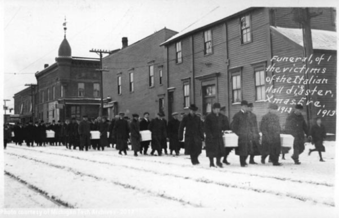
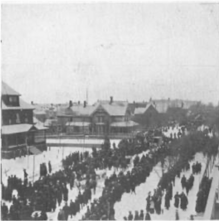
Images courtesy of Michigan Tech University, Houghton, Michigan
Like the sinking of the SS Edmund Fitzgerald, more than a century later, the tragedy of the Italian Hall remains deeply woven into the history and memory of Calumet in the Keweenaw Peninsula through songs, stories, memorials, and the annual lighting of 73 luminaries. The circumstances surrounding the terrible night might never be known, but the families who gathered that night for a Christmas celebration in 1913 are not forgotten.

Sources
[1] eclemens, 24 December 2013, “Subject Focus: The 1913-1914 Copper County Strike and the Italian Hall Disaster,” Walter P. Reuther Library, Wayne State University, Detroit, Michigan, https://reuther.wayne.edu/node/11098.
[2] National Park Service, “Remembering the Italian Hall Tragedy, Keweenaw National Historical Park, https://www.nps.gov/articles/remembering-the-italian-hall-tragedy.htm.
[3] Woody Guthrie, “1913 Massacre,” lyrics, streetdirectory.com.
[4] Michael F. Wendland, “The Calumet Tragedy,” American Heritage, April/May 1986, Volume 37, Issue 3, https://www.americanheritage.com/calumet-tragedy.
[5] Tanda Gmiter, “Photos from the 1913 Italian Hall Disaster,” 19 December 2017, https://www.mlive.com/news/2017/12/photos_from_michigans_italian.html.