As the country celebrates the two hundred and fiftieth anniversary of the Declaration of Independence, it is vital to highlight the contributions of People of Color (and particularly Black Bostonians) to the Revolutionary Era. One of the most notable Black Bostonians may have been Scipio Fayerweather (also written as Fairweather), who had been enslaved by Captain John Fayerweather of Boston. Scipio stated that he purchased a home on Belknap Street in Boston for fifty pounds after his emancipation in around 1760/1761. The British attempted to enlist Scipio into their forces during the Revolutionary War, but he refused because “gratitude to this beloved county in which he has lived from a child made him shudder at the thought.” British troops then destroyed his home and furniture, and on 17 April 1776, he wrote a petition asking for compensation for his losses.1 In their book Robert Love’s Warnings: Searching for Strangers in Colonial Boston, scholars Cornelia Hughes Dayton and Sharon V. Salinger note that Scipio Fayerweather became a landlord and entrepreneur in the city, rented rooms to Black families, and guided Black Bostonians from slavery to freedom.2 He is emblematic of not only People of Color’s contribution to the Revolutionary cause, but also how Black Bostonians used their community and resources to challenge the legality of slavery and the everyday power of enslavers.
Yet as much as Scipio Fayerweather achieved shortly after his emancipation, he too faced challenges in eighteenth century Boston. City records include a complaint from 1766 against Scipio for not participating in four days of highway work, a system of forced labor directed against free Black Bostonians.3 As Jared Hardesty argues in his book Unfreedom: Slavery and Dependence in Eighteenth-Century Boston, a myriad of unfree practices and systems existed in Boston during this time period, and many enslaved people could not struggle for legal emancipation itself, so they fought to improve the circumstances of their lives, families, and communities.4 Scipio Fayerweather, even with his property and his legal freedom, could not escape a society working to entrap and exploit his life and labor. After the legal end of slavery in Massachusetts around 1783, white society attempted to force out many People of Color from New England, reinforcing a system of discrimination and segregation in education, housing, and employment across the region.5
We can look at a Boston court case that occurred more than sixty years before Scipio Fayerweather wrote his petition which further reveals the precarious nature of Black life in the city. In the case of Parrot v. Holmes from 4 October 1715, Bryant Parrot, a baker from Boston, explained that he had purchased a twelve-year-old enslaved boy named Cuffee from James Holmes of Barbados, who had brought the boy from the island on the ship Seaflower. James Holmes had assured Parrot that the boy was “well,” but Cuffee had an ailment in which he experienced “fitts” and could not work. Holmes knew this at the time of the sale, but when Parrot attempted to return Cuffee, Holmes refused to take him back and recompensate Parrot. Indeed, the captain of the ship Seaflower, John Welland, testified that Cuffee had stayed at his home and experienced “fitts” that were so severe that Welland did not wish the boy to continue to reside at his home.6
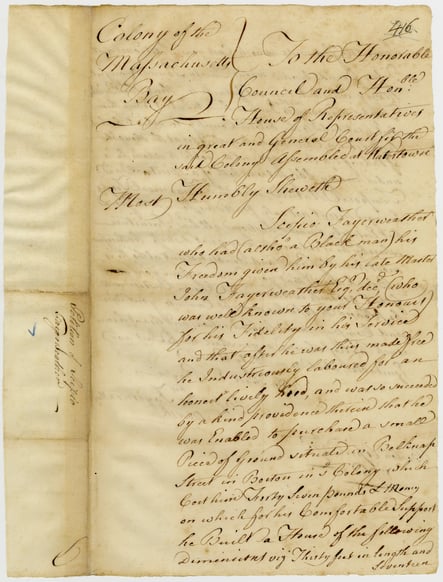 Scipio Fayerweather petition
The case demonstrates utter disregard for Cuffee’s life. In his deposition, Parrot regarded him as “not worth his keeping,” and John Welland and his wife Elizabeth also did not want the boy to remain in their home. The system of slavery in New England centered on neglect, violence, and commodification, as it did everywhere else across the Americas. The case also illustrates the intersection between race and disability that existed within the city. An enslaved boy such as Cuffee with a physical ailment was regarded with particularly little care and a complete lack of humanity. As historian Wendy Warren argued in her book New England Bound: Slavery and Colonization in Early America, slavery in New England was often an isolating experience, where enslaved people experienced violence and forced labor with relatively small communities to help and support them.7 This may have been the experience of Cuffee, taken to Boston from Barbados, separated from family or friends, and enduring violence and neglect with few he knew around him.
Parrot v. Holmes also reveals little about what Cuffee may have thought or felt about his situation. Sometimes in historical and genealogical research we can locate documents written by People of Color, such as Scipio Fayerweather, which can tell us a lot about their lives and how they lived. In other cases, documents on enslaved people in New England often erase the voices of People of Color from the narratives of history. Searching the Suffolk County, MA: Probate File Papers database on the American Ancestors website, we can locate the inventory of the estate of Bryant Parrot from 1755, which includes a reference to “one Negro man” valued at about twenty-six pounds.8 This document alone does tell us about the role of Bryant Parrot as enslaver, but it also serves to commodify this enslaved man, inscribing his role in history through the violence of slavery.
As these snippets of the lives of Scipio Fayerweather and Cuffee demonstrate, Black Bostonians had to navigate a city hostile to their desires, needs, and their very survival. In reading documents from the eighteenth century, including those which celebrate their contributes to the making of the United States, we should keep this context in mind as we interpret how Black Bostonians made history during the Revolutionary era. Life in Boston was complicated for all residents, and although there could be moments of joy and pride, the struggle for survival was an ever-present part of life for People of Color in the city.

Sources
1. Massachusetts State Archives collection, colonial period, 1622-1788, Mass State Archives, v. 180 -- Rev. Petitions (from p.208), 1775-1776, v. 181 -- Rev. Petitions, 1776, pg. 47, Image Group #007703479, image 535 of 1346, viewed on FamilySearch.
2. Cornelia Hughes Dayton and Sharon V. Salinger, Robert Love’s Warnings: Searching for Strangers in Colonial Boston (University of Pennsylvania Press, 2016): 112, 125.
3. A Report of the Record Commissioners of the City of Boston, City Document No. 55, v. 20. 1889, Selectmen's minutes, 1764-1768, pg. 235, Image Group #007939456, viewed on FamilySearch. For more on Scipio Fayerweather also see: Kathryn Grover and Janine V. da Silva, “Error! Main Document Only.Historic Resource Study Boston African American National Historic Site,” December 31st, 2022, National Parks Service.
4. Jared Ross Hardesty, Unfreedom: Slavery and Dependence in Eighteenth-Century Boston (New York University Press, 2016), 2-4.
5. See Richard Archer, Jim Crow North: The Struggle for Equal Rights in Antebellum New England (Oxford University Press, 2017); Joanne Pope Melish, Disowning Slavery: Gradual Emancipation and “Race” in New England, 1780-1860 (Cornell University Press, 1998).
6. “Parrot v. Holmes” no. 10482, October 4th, 1715, Suffolk County (Mass.) court files, [1629-1797], Massachusetts County Court, Suffolk County, v. 100 cases 10472-10591, Image Group #008293905, image 49 of 518, viewed on FamilySearch.
7. Wendy Warren, New England Bound: Slavery and Colonization in Early America (Liveright Publishing Corporation, 2016), 18.
8. Suffolk County, MA: Probate File Papers, Suffolk Cases 10000-11999, no. 10926, 1755, viewed on America Ancestors.