If your family is anything like mine, you may have inherited boxes of photos and heirlooms passed down through generations—items that often end up in closets or the basement once you’ve been designated the “family keeper.”
It goes without saying that many of us feel a deep sentimental connection to the heirlooms once cherished by our direct ancestors. But when it comes to items passed down from distant relatives, that same bond isn’t always there—and we may find ourselves wondering whether we really need to keep everything that’s been handed down.
In my case, one of those “questionable” items was a pair of bronzed baby shoes. Darling as they are, I already have children of my own and countless boxes of keepsakes that take up space. At some point, we all have to decide what to keep and what to let go of—but for whatever reason, no one in my family every parted with these shoes, not even my maternal great-aunt, who passed them down to my mother.
Thankfully, my great-aunt was meticulous in her record keeping and had once served as the “family keeper” herself. Because of her care, we know the shoes once belonged to her first cousin, Billy G. Gonser—whose grandparents were my second great-grandparents – making me his second cousin, twice removed.
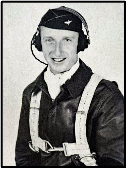
For years, I thought of the shoes as one of those heirlooms I would eventually find a better home for one day. In January 2021, they took on a much deeper meaning. That month, my family was contacted by a genealogist on behalf of the U.S. Army Casualty Office, Past Conflict Reparations Branch (PCRB). We were asked to provide a Family Reference Sample (DNA) for First Lieutenant Billy G. Gonser, who had been killed in World War II on September 12, 1944, and listed as missing in action.
My mother remembers hearing about her aunt and mother’s cousin who died in the war—especially the heartache it caused his mother—but she knew little else about the circumstances surrounding his death. Naturally, I decided to do a bit of sleuthing on my own.
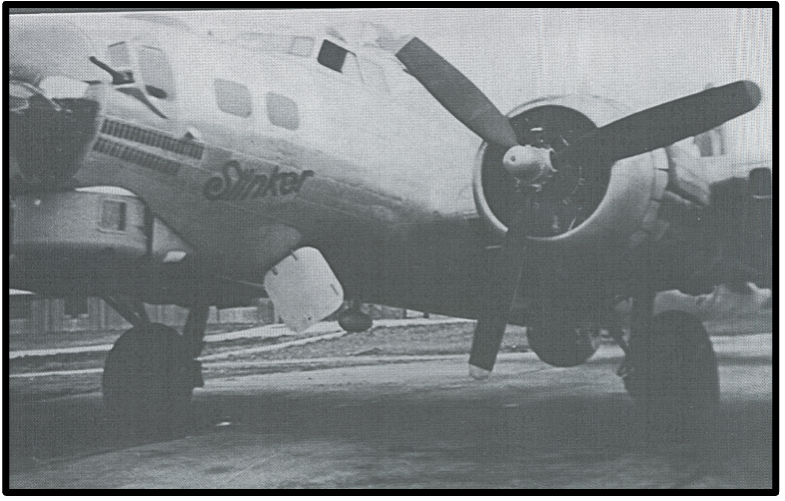
The Stinker, Nuthampstead Airfield Museum collection, image courtesy of the American Air Museum, Britain.
My research revealed that First Lieutenant Gonser had been assigned to the 398th Bombardment Group, stationed at Nuthampstead, a heavy bomber base outside London, England. On the day of his death, he flew with eight fellow airmen of the 602nd Bomb Squadron, led by pilot James S. Field, aboard a B-17 Flying Fortress nicknamed the Stinker. Their operational mission that day was to bomb a chemical plant in Brux, Czechoslovakia.1
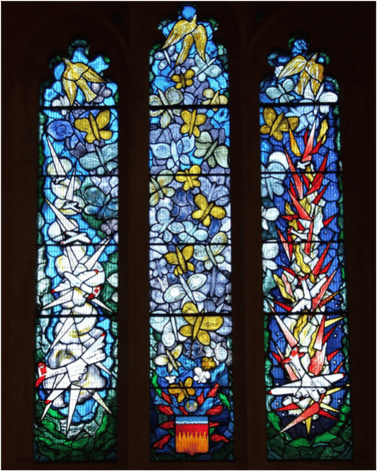
Memorial Window at St George Church, Anstey with butterflies representing each bomber lost and the crews names etched in the wings. Image courtesy of Wikimedia Commons
In June 2000, the Church of St George at Anstey, Hertfordshire, England installed a stained-glass window honoring the men of the 398th, including the crew of the Stinker, who lost their lives while serving at Nuthampstead. Their names are also etched on the Walls of the Missing at Cambridge American Cemetery in Cambridge, England.2 Alongside my ancestor, the other airmen aboard the Stinker were:
Pilot James B. Fields
Navigator Goodrich C. White Jr.
Top Turret Gunner Edward L. Mullendore
Radio Operator Richard S. Goodman
Right Waist Gunner Marvin F. Leach
Ball Turret Gunner James H. Somers
Tail Gunner George N. VanLuven
According to the 398th Bomb Group Memorial Association, every airman aboard the Stinker was originally listed as killed in action. Many years later, however, it was discovered that the co-pilot, Lyman N. Cranston Jr., had actually survived— a story unto itself for another time.3
In an interview, Cranston recalled having just met Gonser, the bombardier, that morning, as Gonser was “finishing up his mission slate with Fields crew.” According to Cranston, their B-17 bomber was hit twice by German fighters that day. The first attack came from a Focke-Wulf Fw 190, which damaged their engines and made it impossible to maintain formation. As a result, Fields and Cranston decided to divert to Sweden, about 60 miles away, rather than attempt the 400-mile journey back to Nuthampstead. Just shy of the Swedish coast, their plane was struck again—this time by a Messerschmidt Bf 109. Cranston recounted the crew’s final moments before the B-17 plunged into the Baltic Sea:
“We were immediately on fire and Fields rang the bail-out bell. I got to the front hatch and motioned for White to jump. He said “go ahead” and so I jumped. At the same time I hit the water the plane also hit and exploded. It came in on fire at 45 degrees. Nobody still in the plane could have survived that crash.” 4
Cranston claimed that the bodies—the navigator, Goodrich White and pilot, James S. Fields—were recovered by the Swedish Navy after the crash.
After reading Cranston’s recollections and reviewing both the Individual Deceased Personnel File and Missing Air Crew Report for my ancestor, I couldn’t help but wonder why the PCRB was requesting our DNA seventy-six years later. By every account, the crew had long been deemed “non-recoverable” and even my follow-up conversations with the Defense POW/MIA Accounting Agency offered no real explanation. As far as we understood, the request was simply part of the agency’s effort to collect samples from relatives of all soldiers designated as MIA.
Then, one day, I stumbled upon a short one-minute video from 2015 titled “Propeller found off Sweden may be from doomed WW2 bomber.” The footage showed divers who believed they had located the wreck of the Stinker off Sweden’s southern coast.5 It is difficult not to let our hopes rise, especially since the sea has returned lost airmen before. In 2018, the remains of Second Lieutenant James R. Lord were recovered almost seventy-five years after his plane crashed into the Mediterranean Sea on 10 August 1944.6
Like the families of 80,000 American service men and women still unaccounted for, ours can only hope that one day our ancestor’s name—etched on the Walls of the Missing at Cambridge American Cemetery—will bear a small rosette, signifying that his remains have at last been accounted for.
Until that day comes, we hold onto hope that First Lieutenant Billy G. Gonser will be recovered from the depths of the Baltic Sea and brought home to rest beside his mother—the same mother who cherished his bronzed baby shoes and passed them down so that he, and his sacrifice, would never be forgotten.

Sources
1. Allen Ostrom, “All KIA Just Wasn’t So,” 398th Bomb Group Memorial Association.
2. The Creative Historian, “Advent Day 3 – Anstey Church,” 2 December 2016, creativehistorian.co.uk and Ostrom, “All KIA Just Wasn’t So,” 398th Bomb Group Memorial Association.
3. Ostrom, “All KIA Just Wasn’t So,” 398th Bomb Group Memorial Association.
4. Ostrom, “All KIA Just Wasn’t So,” 398th Bomb Group Memorial Association.
5. Yahoo!news, “Propeller found off Sweden may be from doomed WW2 bomber,” updated 4 March 2015, Yahoo.com.
6. Amanda Jackson and Alex Medeiros, “This WWII pilot was missing for almost 75 years. On Saturday his remains were finally returned home,” 16 June 2019, CNN.com.