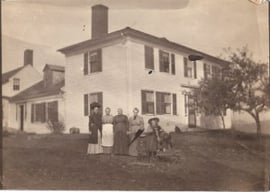
The earliest houses built in Rhode Island, beginning with the first settlement by Reverend William Blackstone in the area now known as Cumberland, were different from..
Continue readingFinal assessment
As I tie up loose ends on the Early New England Families Study Project sketch for Richard Newton, it is time to assess the work.
Newton’s sketch is fairly short, four pages at the moment: his birth and ancestry are unknown, he did not participate in..
Continue reading →As I have mentioned in a previous post, my grandfather was raised in the northeastern Connecticut town of Woodstock, a..
Continue reading →When my mother was diagnosed with ALS in 2009, our family had the first of many discussions about her end-of-life plans. Never one to shy away from difficult topics, Mom expressed her..
Continue reading →Among the prizes in my grandfather’s box of family papers is a small double daguerreotype case containing images of my great-great-grandparents, Gilbert Livingston Beeckman (1824–1874) and Margaret Atherton Foster (1832–1904)...
Continue reading →One of the envelopes in my box of family papers turns out to contain material on my great-grandfather Campbell Steward (1852–1936) as a boy, as well as a letter written to his married daughter in Europe shortly before his death. Another item caught my eye: a vivid..
Continue reading →My grandfather died almost 25 years ago, and sometime before that he gave me a box of “family papers.” The box itself is rather striking: a metal strong box, easily portable, with my great-great-grandfather John Steward’s name stenciled on top in fading paint. Inside..
Continue reading →While searching for online records for Bremen, Germany, I came across a digitized collection of Bremen address books spanning the period 1794–1955 with the help of the website German Roots. The Bremer Adressbücher 1794-1955 (Bremen Address Directories) database has..
Continue reading →I was fascinated by the story released in The New York Times last Wednesday regarding the DNA research to help establish that Warren..
Continue reading →Recently a colleague mentioned a web-based series of interactive discussions called “Windows to the Past: Discovering History Through Tangible Things,” in which “participants will assess fascinating objects . . . to see how any material thing, when examined closely,..
Continue reading →