 In genealogical research, discovering the names of ships on which immigrant ancestors came to the New World is interesting not only as a discrete fact, but because it can often be a clue for further research. As there was a tendency for members of communities to travel together, knowing the names of ships and the places of origin of the ships’ passengers is helpful in understanding the composition of communities and revealing where to search for related, elusive ancestors.
Unlike more modern listings of passengers for the nineteenth and twentieth centuries, compiled by the shipping companies in official ship manifests for departures and arrivals, for the seventeenth century no such official ship passenger lists were created. Rather, records were created dockside and survive primarily in two other sources: Port Books and Licenses to Pass Overseas.
For the seventeenth century, the most modern resource for information on early immigrants to New England is The Great Migration Study Project by Robert Charles Anderson, as it represents the most up-to-date and comprehensive scholarship in the field for early New England research.
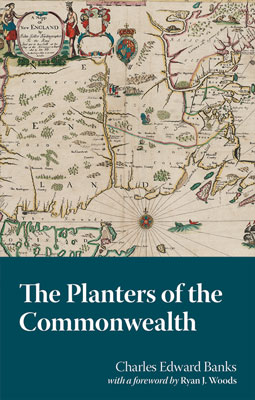
Charles Edward Banks’ Planters of the Commonwealth represents one of the three most important sources of passenger lists for the Great Migration Study Project. First published in 1930 by the Founder’s Memorial Committee for the Boston Tercentenary, Planters sought to provide a comprehensive list of settlers to Massachusetts between 1620 and 1640 as identified by the ship on which settlers arrived, and when known, their place of origin and place of first removal after arrival.
The volume is made-up of two parts: first, an essay, “A Study of Emigration to New England in Colonial Times,” which examines the main locations from which passengers emigrated and the socio-economic conditions under which the immigrants lived before their arrival to the New World. The second portion of the book, which is of primary value to genealogists, provides passengers lists, organized by ship, with information about the port of embarkation of each vessel, the date the ship arrived in America, the place of origin in England of the passengers, and where the passengers resided once in New England.
Between 1922 and 1926, Banks spent more than three years in England poring over shipping lists at the Public Records Office (now the National Archives). Through synthesis of the records in the Public Records Office, the High Court of the Admiralty, materials published in The New England Historical and Genealogical Register, and bolstered by previous research – Banks published 126 works in his lifetime – he was able to augment John Camden Hotten’s The Original Lists of Persons of Quality, which had hitherto been the largest work of seventeenth-century passengers, by 1,500 immigrants.
In total, Planters contains key information on more than 3,600 immigrants to the New World between 1620 and 1640. As with any work its kind, fact-checking is required, but Planters is still one of the four most importance sources for early ships and passengers to America, and along with the volumes of the Great Migration Study Project, Hotten, and Peter Wilson Coldham’s The Complete Book of Emigrants, 1607–1660, it belongs on the bookshelf of every genealogist researching early New England.
Adapted from the foreword to Charles Edward Banks’ The Planters of the Commonwealth.