---
title: The Origins of County Histories, Biographical Sketches, and Mug Books
description: How local histories and the biographical sketches that often accompany them rose in popularity during the centennial, and how they've changed since.
image: https://vitabrevis.americanancestors.org/hubfs/county-histories.jpg
---
# [Vita Brevis A resource for family history from AmericanAncestors.org](https://vitabrevis.americanancestors.org/)
This is a search field with an auto-suggest feature attached.
- There are no suggestions because the search field is empty.
# The Origins of County Histories, Biographical Sketches, and Mug Books
[February 10, 2026](https://vitabrevis.americanancestors.org/the-origins-of-county-histories-biographical-sketches-and-mug-books) [American History](https://vitabrevis.americanancestors.org/tag/american-history), [Research tips](https://vitabrevis.americanancestors.org/tag/research-tips) [Jennifer Shakshober](https://vitabrevis.americanancestors.org/author/jshakshober)
The dubious quality of published genealogies and local histories is a common lament of genealogists. Some publications, of course, responsibly cite original documents such as land deeds, church records, and probates. Others supply neither footnotes nor bibliographies, making our job of verification that much harder. Often the uncited histories still include an author's note regarding sources, but in many instances the book presents information on families derived from the author's own correspondence with descendants rather than from contemporaneous records. We are usually not afforded the chance to examine the author's sources for ourselves (though if you're lucky, the author has donated his manuscript and research notes to a public archive!)
County histories and biographical sketches exploded in popularity following the Civil War. Congress even made the writing of community histories a focal point of the centennial in 1876, requesting that the states:
"...cause to have delivered on [the centennial anniversary] an historical sketch of said county or town from its formation, and that a copy of said sketch may be filled, in print or manuscript, in the clerk's office of said county, and an additional copy...be filed in the office of the Librarian of Congress, to the intent that a complete record may thus be obtained of the progress of our institutions during the first centennial of their existence."
National pride manifested in the form of newspaper columns, pamphlets, and full-length monographs. Writing in 1954, Harry R. Stevens of Duke University determined that the prerequisites for writing a county of local history were "sufficient prosperity and material wealth to provide support for it, and the existence of a sufficiently cohesive community within the county." The relative affluence of the Northern states during this period explains why local history writing flourished there and not in the fractured communities of the American South.
A distinct category of history writing emerged: the commercially produced "mug books," kept afloat by subscribers. During the last quarter of the nineteenth century, men of local renown commissioned these projects to record their accomplishments for posterity. When genealogists groan about the popular usage of published histories, they usually have these specific books in mind.
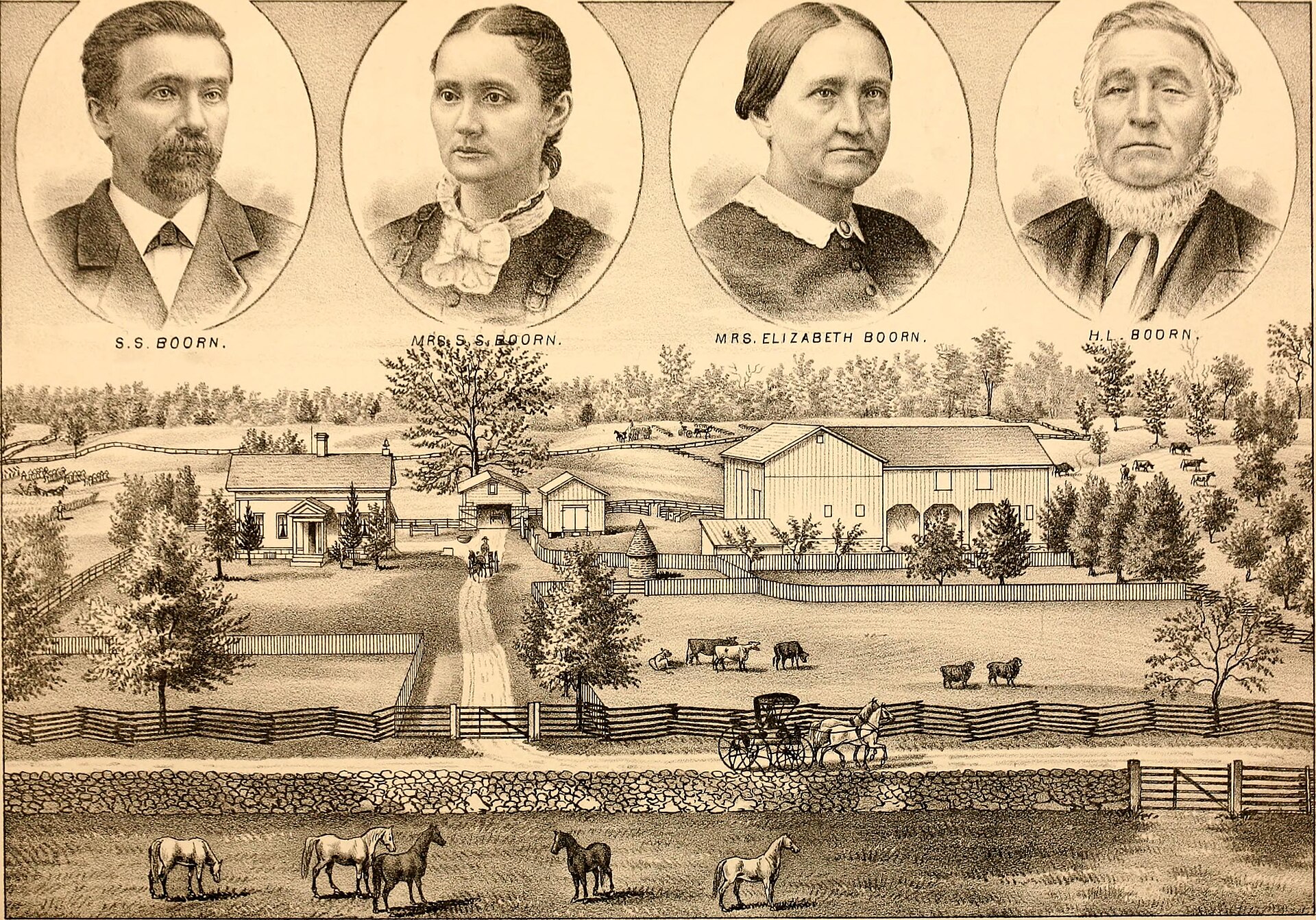*Residence of the late Harvey L. Boorn from the "History of Ingham and Eaton counties, Michigan"*
In a 1989 literature review for *The Public Historian, *John Long and Peggy Tuck Sinko assess the character of these earlier books. They point out that modern histories printed to commemorate the nation's bicentennial in 1976 record local events with an analytical approach that the late nineteenth-century histories often lack. Whereas the centennial-era volume privilege "justices of the peace, Civil War veterans, clergymen," the newer works introduce us to marginalized figures—"women...hired hands and laborers, and lower-paid professionals"—or at the very least challenge us to interrogate the status quo.
I have always appreciated these more nuanced, comprehensive histories. But reading Long and Sinko's 1989 review, I reevaluated my views on nineteenth-century published histories as genealogical source material, too. Some of the nineteenth-century examples are quaint at best and harmful at worst; their authors do not have the final say. But their value, best explained by the aforementioned authors, is that "these works contain much information found in no other sources." People old enough to remember the centennial and have memories predating the occasion were not alive in 1976. Their recollections, however, are sometimes all we have.
[ ](https://vitabrevis.americanancestors.org/hs/cta/wi/redirect?encryptedPayload=AVxigLLYkCI62C%2F8gnUGGHshVg1zAN4YI2uqadGjr8tJPLNt61h1CV0j%2FMDJ3Z1WSxbcAO4DLLGi3QtXvpLDRVik2pC08wrKUMk0YQWLTO9AdFbB0DNwbf43t9kvAHeR4t2yn1NWBbMayNXA5eUnpRxLJN0OGO6E%2Fz9pgLgWW0QkPn%2FBnM%2F3eKfhKaY%3D&webInteractiveContentId=207187270804&portalId=4306738)
### Share this:
- [mailto:?body=https://vitabrevis.americanancestors.org/the-origins-of-county-histories-biographical-sketches-and-mug-books](mailto:?body=https://vitabrevis.americanancestors.org/the-origins-of-county-histories-biographical-sketches-and-mug-books)
-
-
- More
-
-
## About Jennifer Shakshober
Jen earned a dual B.A. in English and Economics from Westfield State University, an M.F.A. in Creative Nonfiction from Bennington College, an M.L.I.S. in Archives Management from Simmons University, and a certificate in Genealogical Research from Boston University. In 2018, she completed a graduate internship at Old Sturbridge Village's Research Library, where she arranged an early nineteenth century manuscript collection. Areas of Expertise: Massachusetts, Connecticut, Vermont, North Carolina, Virginia, and Maryland.[View all posts by Jennifer Shakshober →](https://vitabrevis.americanancestors.org/author/jshakshober)
[← Following a Wandering Ancestor](https://vitabrevis.americanancestors.org/wandering-ancestor)
[Is Cécile Related to Bad Bunny? →](https://vitabrevis.americanancestors.org/is-cécile-related-to-bad-bunny)
This is a search field with an auto-suggest feature attached.
- There are no suggestions because the search field is empty.
### Recent Posts
[Charles Bulfinch – A Father of Federal Style Architecture](https://vitabrevis.americanancestors.org/charles-bulfinch)
[Sailor Bill and His Forgotten Wife](https://vitabrevis.americanancestors.org/sailor-bill-and-his-forgotten-wife)
[Professor X](https://vitabrevis.americanancestors.org/professor-x)
[Part I: Malaga Island, Maine](https://vitabrevis.americanancestors.org/part-i-malaga-island-maine)
[The Norwegian folge](https://vitabrevis.americanancestors.org/the-norwegian-folge)
### Archives
- [October 2014 (27)](https://vitabrevis.americanancestors.org/archive/2014/10)
- [December 2015 (24)](https://vitabrevis.americanancestors.org/archive/2015/12)
- [July 2020 (24)](https://vitabrevis.americanancestors.org/archive/2020/07)
- [April 2014 (23)](https://vitabrevis.americanancestors.org/archive/2014/04)
- [July 2014 (23)](https://vitabrevis.americanancestors.org/archive/2014/07)
- [December 2014 (23)](https://vitabrevis.americanancestors.org/archive/2014/12)
- [July 2015 (23)](https://vitabrevis.americanancestors.org/archive/2015/07)
- [March 2017 (23)](https://vitabrevis.americanancestors.org/archive/2017/03)
- [May 2017 (23)](https://vitabrevis.americanancestors.org/archive/2017/05)
- [August 2017 (23)](https://vitabrevis.americanancestors.org/archive/2017/08)
- [January 2018 (23)](https://vitabrevis.americanancestors.org/archive/2018/01)
- [March 2014 (22)](https://vitabrevis.americanancestors.org/archive/2014/03)
- [August 2014 (22)](https://vitabrevis.americanancestors.org/archive/2014/08)
- [April 2015 (22)](https://vitabrevis.americanancestors.org/archive/2015/04)
- [September 2015 (22)](https://vitabrevis.americanancestors.org/archive/2015/09)
- [October 2015 (22)](https://vitabrevis.americanancestors.org/archive/2015/10)
- [March 2016 (22)](https://vitabrevis.americanancestors.org/archive/2016/03)
- [June 2016 (22)](https://vitabrevis.americanancestors.org/archive/2016/06)
- [August 2016 (22)](https://vitabrevis.americanancestors.org/archive/2016/08)
- [September 2016 (22)](https://vitabrevis.americanancestors.org/archive/2016/09)
- [November 2016 (22)](https://vitabrevis.americanancestors.org/archive/2016/11)
- [December 2016 (22)](https://vitabrevis.americanancestors.org/archive/2016/12)
- [January 2017 (22)](https://vitabrevis.americanancestors.org/archive/2017/01)
- [June 2017 (22)](https://vitabrevis.americanancestors.org/archive/2017/06)
- [November 2017 (22)](https://vitabrevis.americanancestors.org/archive/2017/11)
### Categories
- [Family stories (1260)](https://vitabrevis.americanancestors.org/tag/family-stories)
- [American History (1137)](https://vitabrevis.americanancestors.org/tag/american-history)
- [Critical Analysis (1126)](https://vitabrevis.americanancestors.org/tag/critical-analysis)
- [Research Methods (881)](https://vitabrevis.americanancestors.org/tag/research-methods)
- [Brick Walls (674)](https://vitabrevis.americanancestors.org/tag/brick-walls)
- [Object Lessons (617)](https://vitabrevis.americanancestors.org/tag/object-lessons)
- [Spotlight (617)](https://vitabrevis.americanancestors.org/tag/spotlight)
- [Genealogical Writing (554)](https://vitabrevis.americanancestors.org/tag/genealogical-writing)
- [Research tips (510)](https://vitabrevis.americanancestors.org/tag/research-tips)
- [Serendipity (479)](https://vitabrevis.americanancestors.org/tag/serendipity)
- [Road Trips (393)](https://vitabrevis.americanancestors.org/tag/road-trips)
### Recent Posts
[Charles Bulfinch – A Father of Federal Style Architecture](https://vitabrevis.americanancestors.org/charles-bulfinch)
[Sailor Bill and His Forgotten Wife](https://vitabrevis.americanancestors.org/sailor-bill-and-his-forgotten-wife)
[Professor X](https://vitabrevis.americanancestors.org/professor-x)
[Part I: Malaga Island, Maine](https://vitabrevis.americanancestors.org/part-i-malaga-island-maine)
[The Norwegian folge](https://vitabrevis.americanancestors.org/the-norwegian-folge)
### Meta
- [Log in](https://vita-brevis.org/wp-login.php)
- [Entries RSS](https://vita-brevis.org/feed/)
- [Comments RSS](https://vita-brevis.org/comments/feed/)
- [WordPress.org](https://wordpress.org/)
### Subscribe to Blog via Email
Enter your email address to subscribe to this blog and receive notifications of new posts by email.
### Archives
- [October 2014 (27)](https://vitabrevis.americanancestors.org/archive/2014/10)
- [December 2015 (24)](https://vitabrevis.americanancestors.org/archive/2015/12)
- [July 2020 (24)](https://vitabrevis.americanancestors.org/archive/2020/07)
- [April 2014 (23)](https://vitabrevis.americanancestors.org/archive/2014/04)
- [July 2014 (23)](https://vitabrevis.americanancestors.org/archive/2014/07)
- [December 2014 (23)](https://vitabrevis.americanancestors.org/archive/2014/12)
- [July 2015 (23)](https://vitabrevis.americanancestors.org/archive/2015/07)
- [March 2017 (23)](https://vitabrevis.americanancestors.org/archive/2017/03)
- [May 2017 (23)](https://vitabrevis.americanancestors.org/archive/2017/05)
- [August 2017 (23)](https://vitabrevis.americanancestors.org/archive/2017/08)
- [January 2018 (23)](https://vitabrevis.americanancestors.org/archive/2018/01)
- [March 2014 (22)](https://vitabrevis.americanancestors.org/archive/2014/03)
- [August 2014 (22)](https://vitabrevis.americanancestors.org/archive/2014/08)
- [April 2015 (22)](https://vitabrevis.americanancestors.org/archive/2015/04)
- [September 2015 (22)](https://vitabrevis.americanancestors.org/archive/2015/09)
- [October 2015 (22)](https://vitabrevis.americanancestors.org/archive/2015/10)
- [March 2016 (22)](https://vitabrevis.americanancestors.org/archive/2016/03)
- [June 2016 (22)](https://vitabrevis.americanancestors.org/archive/2016/06)
- [August 2016 (22)](https://vitabrevis.americanancestors.org/archive/2016/08)
- [September 2016 (22)](https://vitabrevis.americanancestors.org/archive/2016/09)
- [November 2016 (22)](https://vitabrevis.americanancestors.org/archive/2016/11)
- [December 2016 (22)](https://vitabrevis.americanancestors.org/archive/2016/12)
- [January 2017 (22)](https://vitabrevis.americanancestors.org/archive/2017/01)
- [June 2017 (22)](https://vitabrevis.americanancestors.org/archive/2017/06)
- [November 2017 (22)](https://vitabrevis.americanancestors.org/archive/2017/11)