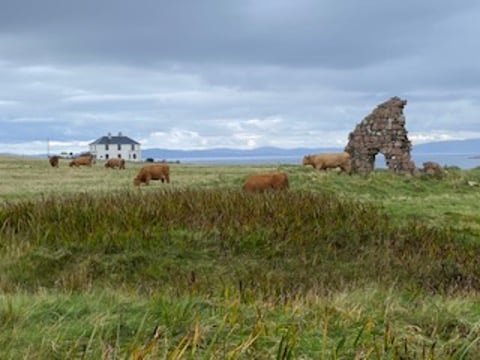
The Isle of Iona, looking upon highland cows, ruins of an old structure, and the mountains of the Isle of Mull across the bay.
In the fall of 2022, I studied abroad for the last semester of my undergraduate degree in Edinburgh, Scotland, at the University of Edinburgh. While there, I took two classes that influenced me significantly: Ancient Celtic Literature in Translation and Scotland and Orality. In pursuit of my Irish Studies minor, I added these classes to my schedule without realizing how profound it would be to carry these tales—many of which were inspired by the history and traditions of this land—as I explored Scotland.
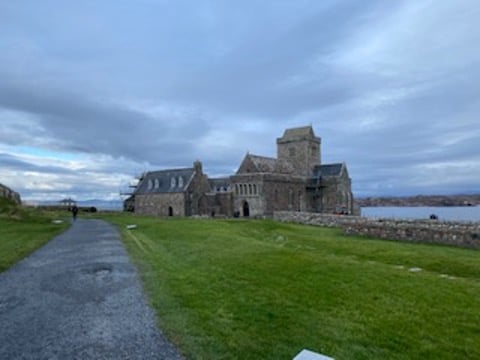
Iona Abbey looking upon the bay that separates the Isle of Iona and Mull
In my program, we had a weekend excursion planned that took us through the highlands of Glencoe, along the seacoast to Oban, and through the Inner Hebrides of Mull, Iona, and Staffa. These three small islands make up only a fraction of the Inner and Outer Hebrides—thousands of relatively close, scattered islands along the western coast of Scotland.
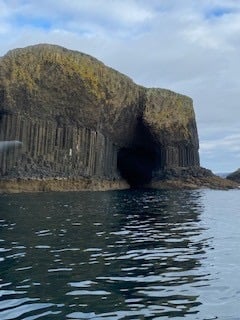 Isle of Staffa, medieval monks from Iona would sail to uninhabited Staffa to pray and find a closer connection to God
Leading up to our excursion, my Ancient Celtic Literature class had touched upon tales inspired by St. Columba. St. Columba was originally from Ireland and settled on the Isle of Iona in 563 AD alongside twelve companions to build a monastic community. The abbey and nunnery built on Iona are believed to be the birthplace of Christianity in medieval Britain. The Irish sagas we read in class were most likely written hundreds of years after the real St. Columba died.
Peregrinatio pro amore Dei, according to the University of York, means "pilgrimage for the love of God." Celtic monks—taking inspiration from the people of Israel who traveled through the wilderness to reach the Promised Land—would seek out uninhabited lands in which to pray and fight the forces of evil. In these sagas, the main character would voluntarily exile themselves from their everyday life to find a close relationship with God and His gospels, as seen as a sort of rite of passage.
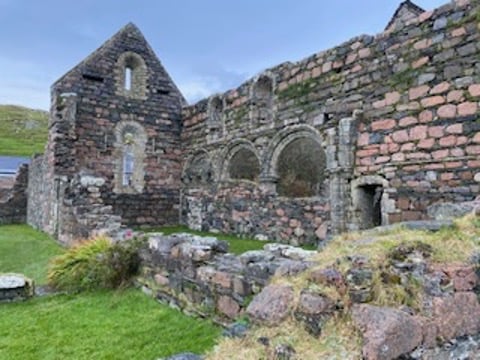 Iona Nunnery, part of Iona Abbey, on the Isle of Ion
When I explored the Isle of Iona—including the abbey and nunnery—the sagas of Immrama and Voyage of Bran felt more vivid and tangible. Even though they include fantastical themes of "otherworlds," I couldn't help but see parallels between these sagas and my own ancestors' journeys.
Many of my ancestors immigrated to the United States from Ireland, Britain, and Sweden. Whether due to a lack of opportunity or something else, they too had to leave home and family as an act of faith, hoping they would find safety, security, and happiness on the other side. The long and often arduous journeys they embarked upon could be treacherous—full of situations they had never encountered in their small villages and towns—with no way of knowing whether their actions would lead to success or failure. Leaving home relatively destitute and sometimes alone, acting on faith and holding onto hope for a better life was all they had. I wouldn't be where I am, or who I am, without them.