I have written a genealogical biography of Nils Trulsen Bru (1776-1823), my 3rd Great Grandfather, who lived and died in Norway. It has been interesting to learn the customs of that time. Our ancestors did not enjoy the benefits of Social Security or well-funded retirement plans. When they reached retirement age, they turned the farm over to the next generation and, in return, received a promise of benefits.
In Norway two centuries ago, the promise was written in a document called a folge or kårbrev, which is a pension contract or a letter of care. I searched the Norwegian archives and found that, in 1810, Nils Trulsen executed a folge in favor of his parents. You can see it yourself at https://media.digitalarkivet.no/view/22826/415. Full confession, I found a Norwegian history professor who transcribed the handwritten Danish into modern Norsk and AI did the rest. You will note that I refer this ancestor as NTB, and yes, his name was spelled differently back then.
I have included the retirement promise in Chapter 19 of the forthcoming volume To My Beloved Norwegian Countrymen.
1810 Accepting his Patrimony
NTB's acceptance of his patrimony—and his step into full adulthood—came in 1810, when he executed a pension contract (folge) in favor of his parents. In 1807, he had received the lease deed as the transferee. Now, three years later, he acted as the transferor—the giver rather than the recipient. He assumed a personal financial obligation, secured by the farm, to provide for his aging parents. It was, in every sense, a grown-up act.
The full text of that contract follows.
No. 5 […] 1810. Pension Contract. (Folge)
I, the undersigned Niels Truelsen of Broe Farm in Aschøe Parish, hereby declare:
That, as per the legally granted Lease Deed of April 15, 1807, recorded on June 11, 1807, I have leased in consideration of 1 ½ Pounds of grain on Broe Farm, Matrikkel No. 11, in Aschøe Parish. Now, therefore, I hereby promise and agree to provide the following annual support or livelihood to my dear parents, Truels Larsen and Berthe Nielsdatter, who reside on that farm:
- They shall annually receive 8 barrels of oats, measured at 8 Spand (a Danish volume measure) per barrel; half a barrel of barley, half a barrel of malt, and 1/4 barrel of rye, all well cleaned and delivered at the appropriate time.
- I shall provide them 2 cows and 8 sheep and care for these animals, both in winter and summer, as well and responsibly, as the other animals on the farm.
- They shall have annual use of good land suitable for planting a quarter of a barrel of potatoes provided by me and additionally receive a quarter of a pig.
- They shall have free lodging, light, firewood, and assistance both in times of health and especially in illness. When one of the beneficiaries dies, the survivor shall receive only half of the aforementioned support, except for caring for their livestock, which shall continue in full as long as one of the beneficiaries is alive.
This support, which has been appraised by two men at 77 Danish Rigsdaler per year, amounting to a capital of three hundred and eighty-five Danish Rigsdaler for five years,(illegible) after which the stamped paper has been used up?, remains an obligation on and is provided from the aforementioned rent for the Broe Farm, as long as the beneficiaries live, regardless of whoever may come to possess or own this part of the farm.
In confirmation, under my hand, in the presence of two witnesses:
Stavanger, November 20, 1810. Niels Truelsen Broe, holding the pen.
As witnesses: J. Pedersen, O. Andersen.
By formulating this pension contract in a manner nearly conforming to the content of the Lease Deed to Niels Truelsen dated April 17, 1807, with the slight addition that the surviving beneficiary shall continue to receive the mentioned animals' fodder, it is not inappropriate, considering the circumstances of this usage, to which I, as the administrator, fully consent.
Stavanger, November 24, 1810. B. Rosenkilde.
Recorded on February 2, 1811. Paid for the writing beforehand. For the registration, 12 ½ percent was paid, totaling 3 ort.
Attest E. Schiøtz.
Transcribed from the archives by Professor Nils Olav Østrem.
Returning to Bru
It's my supposition that NTB returned to full-time residency at Bru around the time he executed the folge or shortly thereafter. The church book notes that he was still living at Dale when his son Daniel was born in December 1808. By March 1811, when Truls was born, his residence was listed as Bru. The pension contract was signed on November 24, 1810, and I believe NTB and Kristi moved back to Bru that December—just ahead of the return of the spring herring.
According to the custom of the time, once NTB became the registered head of the household, he would have sat at the head of the dining table when they arrived at Bru, with Kristi at the foot; his parents Truls and Berith would have moved to the sides. A small matter, perhaps—but one that made visible what the contract had made legal. The children would have noticed the change in their parents' place at the table, and understood, without being told, that something had shifted.
The pension contract closely mirrored the earlier lease deed, enough so that the bishop's agent gave his "full consent" without hesitation. One notable difference was not an addition, but an omission: the contract no longer specified the right to build a cabin for Truls and Berith. It appears they all lived happily together—three generations under one roof on Bruk 4, Bru Island.
Meanwhile, the herring had returned in abundance during the winter and spring of 1810 and would again be plentiful in 1811. In fact, they continued to appear reliably each season for the rest of NTB's life. That renewed prosperity surely steadied him as he took on the responsibilities of running the family farm and providing for his parents.
A Spelling Shaped by Time
During our family visit to Norway, I would occasionally slip away to meet with Nils Olav Østrem at the archives. One day, after I returned, my granddaughter Thea asked me something I had never really considered: “Why is our family name spelled Brue in America, but Bru in Norway?”
I answered as best I could—that some of the early immigrants spelled it that way, and the spelling stuck, including with my grandfather Nels. But as I thought more about it, I offered another possibility. During Danish times, the name was spelled Broe, meaning “bridge,” and pronounced much like “brew.” It’s possible the immigrants had Broe in mind and changed it to Brue to make the English pronunciation sound as it had in Norway.
In Norway, language reforms—Riksmål, Bokmål, Landsmål, Nynorsk—eventually standardized the spelling as Bru. But in America, the Norwegian immigrants kept using the version they had adopted upon arrival and been using for years.
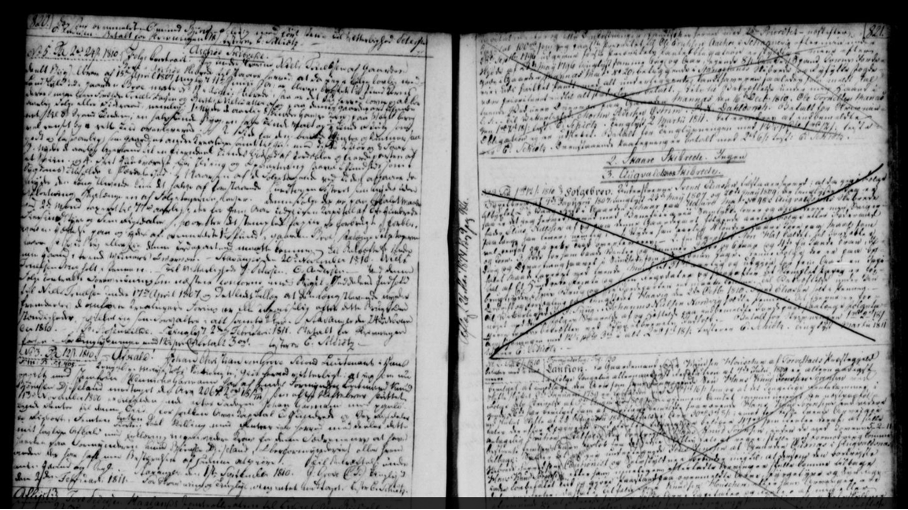 Digital Archives of Norway: Karmsund sorenskriveri, AV/SAST-A-100311/01/II/IIB/L0004: Pantebok nr. A1, 1798-1815, s. 820-821, accessed March 31, 2026.