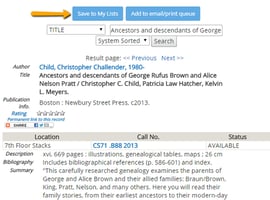
We recently implemented a new feature in the NEHGS library catalog that will make it easier to keep track of library resources that are relevant to your research. The function is called “My Lists,” and it allows you to save lists of titles to your NEHGS library account..
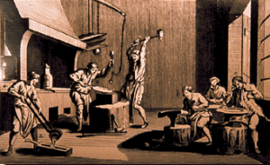
Continue readingYou know the names and dates, but do you know how your early New England ancestors worked to survive? Tracing these individual stories is challenging with limited records, but not impossible.
As a child, I used my allowance to purchase a family tree fan chart at the..
Continue reading →News of King Richard III’s reburial last week was interesting, especially the stories regarding descendants of the King’s sister, who each placed a white rose (the..
Continue reading →A friend recently received a document from a cousin, outlining her family’s ancestry. It was quite long, she said, and mentioned a Mayflower ancestor — but she didn’t know how to interpret it. There were lots of numbers, some of them roman numerals.
My well-trained..
Continue reading →Church records can be a valuable resource when vital records fall short. NEHGS has a large collection of published church records for New England..
Continue reading →One of the things I enjoy most about family research is to go beyond locating ancestors’ names and the dates of birth and death, and find out as much as I can to..
Continue reading →After eleven years on the staff at NEHGS, I finally had to face the fact that I had never investigated my own family history. Colleagues had urged me to undertake my own genealogy, and I always said I would, absolutely . . . some..
Continue reading →Family historians use a variety of records, some of which require some understanding of legal terms. And when it comes to land records, one term that is very often misunderstood..
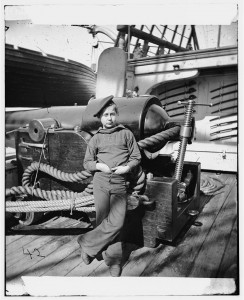
Continue reading →Do you have an ancestor from New Hampshire who was working at sea at the young age of 10 or 12? Have you seen a U.S. Federal Census record that states that your ancestor was a “mariner” at age..
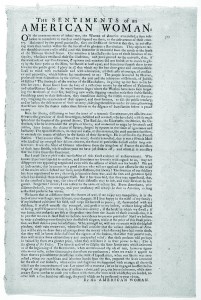
Continue reading →The role of women in America in the seventeenth and eighteenth centuries was not confined simply to matters within their households, as some have..
Continue reading →