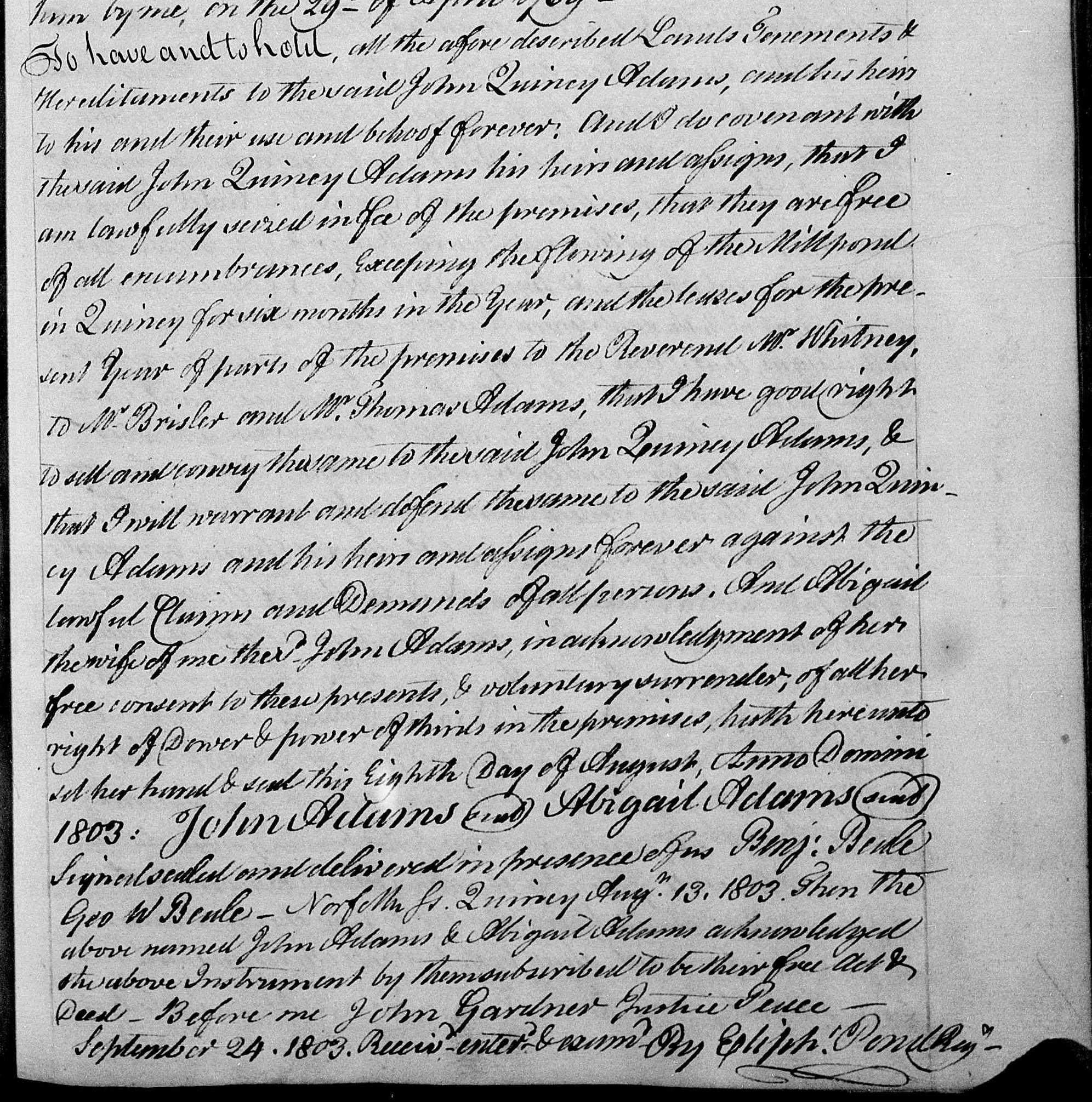
 Land record mentioning Abigail Adams’s "voluntary surrender of all her rights of dower."
Family historians use a variety of records, some of which require some understanding of legal terms. And when it comes to land records, one term that is very often misunderstood is dower. Many look at that word and think of dowery. While both terms have to do with women, marriage, and property, they have different meanings.
Recently I encountered a family historian who was looking for a record that didn’t exist. Her research had turned up a land record that included the following phrase: “Being the same land with a dwellinghouse that was set out to our mother Catherine Olmsted in the settlement of our Father’s estate as her Dower during her natural life.” The researcher had spent a lot of time looking for a deed from Catherine’s father because she had misunderstood the use of the term dower.
Dowery, or dowry, is the term for that portion, usually from her father, that a bride brings to her husband that he can use as long as the marriage lasts. The term dower, on the other hand, is a shortened version of dower right: it refers to the portion of a deceased husband’s estate to which a widow is entitled to by law for her lifetime.
A financially savvy woman, if her husband wrote a will but was in debt at the time of his death, would elect to receive her dower right portion, as it was taken right off the top and not available to the creditors. If she elected to receive what he gave her in the will, then the creditors got their due first and she would be left only with her share of what was left. Unfortunately, few women in the colonial period were aware of such rights.
Most of the time, though, we see the term dower right when a man is selling property, as there is a clause at the end of the deed where the clerk writes that he has talked to the wife and states that she is giving up her dower right without pressure.
If an ancestor lived in a state that had dower rights, we should be able to find a wife’s name in any record of land being sold by her husband during their marriage. Having the wife’s name often helps us differentiate between two men of the same name in a particular area.
Land records can hold many clues for family historians, but one of the best is ownership through dower right or dowry, which can alter by whom and when land can be sold. If it is a dowry, then a father should be listed in the record; the dower right clause requires that a wife’s first name be listed in a deed.