Over the past weeks I have been defining 10 categories to use when assessing the value, or lack thereof, of a genealogy. The question is not “Where do I find a list of the ‘good’ or ‘bad’ genealogies,” but “How do I judge whether a genealogy is good or bad?” For the..
Continue readingIt is one thing for the author of a genealogy to have the goal (or scope) of publishing everything about all the descendants of [blank], and a much, much different thing to achieve that goal.
Clearly, there is no such thing as “everything” and “all.” The author has to..
Continue reading →March is women’s history month, which makes me think of my favorite women’s history..
Continue reading →Originating in an Italian proverb in 1603 and popularized by Voltaire in 1770, we have all heard the phrase “the perfect is the enemy of the good.” This phrase is very well-suited to the topic of searching genealogical databases, and particularly for..
Continue reading →Many of us are avid genealogists who want to trace our ancestry as far back as is reasonable in all lines. When filling out our family trees, we come to some dead ends where lack of information blocks us from going back further. We may also come to situations where..
Continue reading →I first learned the story of Elizabeth Knapp in 1982, when I read Entertaining Satan: Witchcraft and the Culture of Early New England by John Demos. Demos is a master storyteller, and much of the narrative as well..
Continue reading →With the Winter Olympics almost upon us, we will be hearing a lot about “perfect” scores in the sports where judges assign points for such things as technical difficulty and artistic interpretation.
A “scoring” system for genealogies would be interesting. If, for..
Continue reading →On Friday, I wrote about some of the most widely-read Vita Brevis posts of 2017. To mark the beginning of the next year, here are six more popular posts showcasing the range of subjects covered in a blog that publishes about 250 posts a year. (In fact, Vita Brevis..
Continue reading →Applicants to the Society of the Descendants of the Colonial Clergy (SDCC) must have “a proven lineal lawful descent from a clergyman who was regularly ordained, installed, or settled over a Christian church within the limits of the thirteen colonies prior to 4 July..
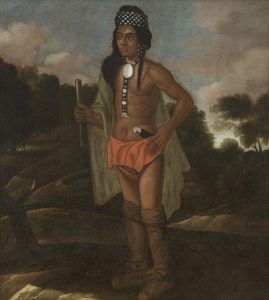
Continue reading →A relatively recent treasure added to the NEHGS collections is a late nineteenth-/early twentieth-century oil painting of a Native American sachem. NEHGS purchased this painting in early 2016 from an art dealer. The portrait is..
Continue reading →