For the past six-and-a-half years, I have served as Pastor of the Pittsford Congregational Church, just two miles from our home. The exterior of the church, with its Gothic architectural elements, has remained largely unchanged since its completion in 1837. My office in the church basement overlooks the Meeting House Cemetery.
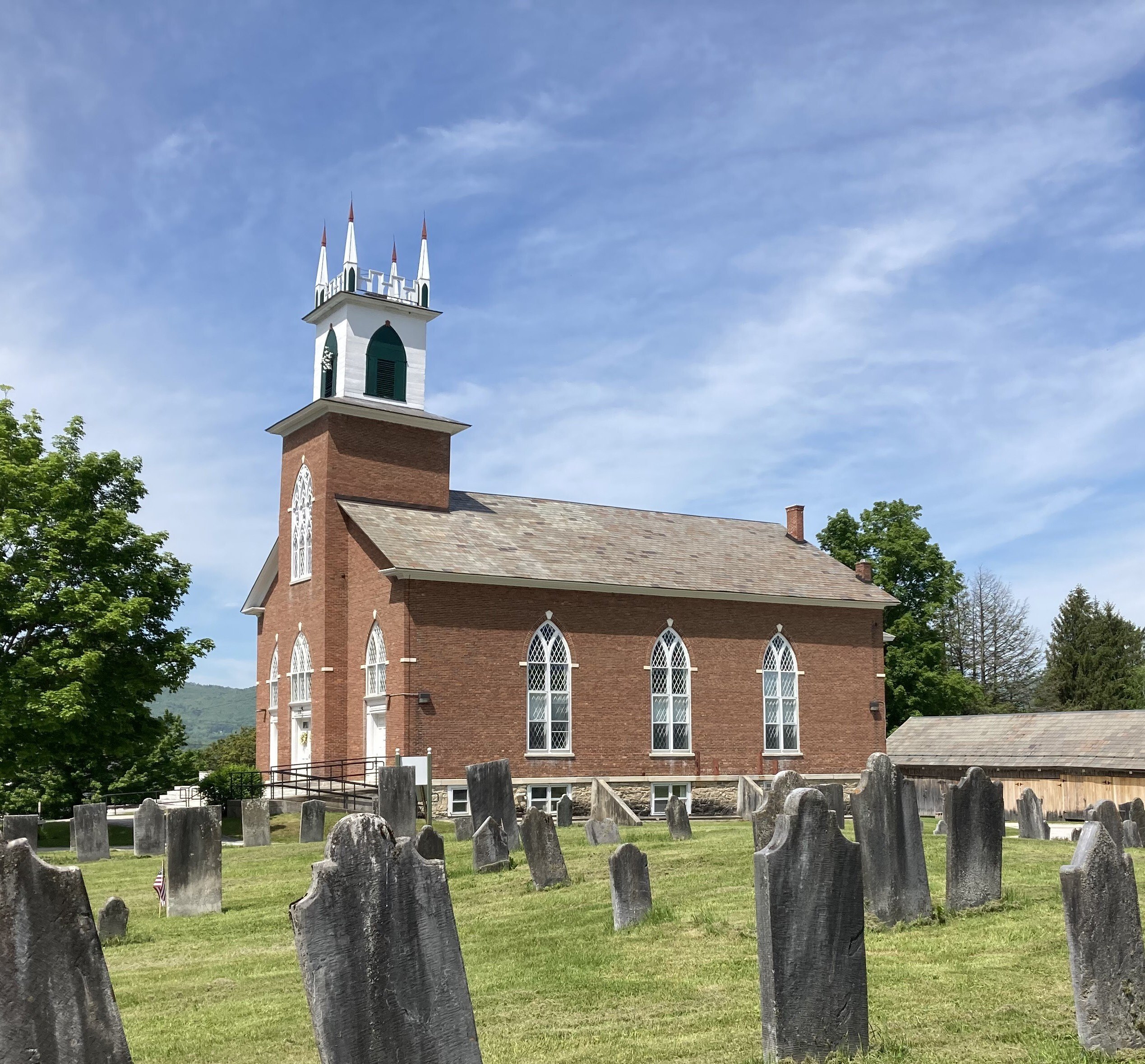
The earliest surviving stone dates to 1784. With the establishment of a more expansive town cemetery, burials ceased there in the late 19th century. Often, as I have gazed out my office window, I mused, “Too bad I don’t know anyone buried there.” That changed in a remarkable way.
One of our deacons now lives in the former parsonage, just a stone’s throw from the church. When a former pastor visited her, she was dismayed to learn that he had taken some broken stones from the cemetery and placed them in front of the house to serve as stepping stones. She and I concurred that the stones, now covered with grass, should be exhumed and returned to the cemetery, but we needed help to accomplish the task.
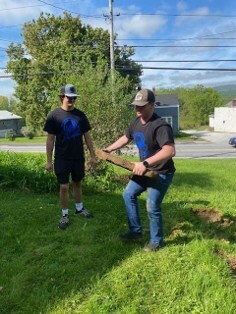
A group of students from the high school where I taught for thirty-five years came on a lovely spring day to complete their chosen community service opportunity. They relished the task of unearthing buried history. The first stone we surfaced had a readable inscription: William Barlow, died December 26, 1824, in his 30th year.
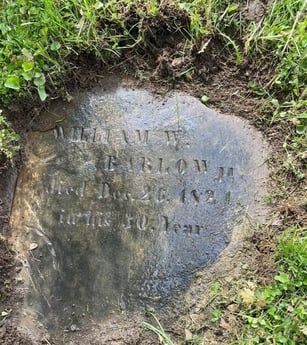
My research discovered that William became a member of the church in 1811, along with his parents, Jirah and Anna (Parmelee) Barlow. Stones for Jirah and Anna still remain upright in the cemetery, and at some point, up until the late 1990s, William’s stone probably stood next to his parents. Margaret R. Jenks had recorded the stone when she inventoried Pittsford Cemeteries in 1991 for part of her series on Rutland County cemetery inscriptions.
The students, genuinely interested in this work, removed several other fragments of stones and returned them to the cemetery. We all felt better knowing that William’s stone now stands near that of his parents rather than remaining as a partially buried stepping stone.
I recognized the Barlow surname as one I had previously researched from Sandwich, Massachusetts. One of William’s ancestors was John Wing (1613–1699) of Sandwich and Harwich, Massachusetts, the progenitor of nearly all Wing families in America. John is also my ancestor, which means William Barlow and his parents, all once members of the Pittsford Congregational Church, are my distant cousins! Little could I have imagined that I have kinfolk buried behind my church.
I recognized the Barlow surname as one I had previously researched from Sandwich, Massachusetts. One of William’s ancestors was John Wing (1613–1699) of Sandwich and Harwich, Massachusetts, the progenitor of nearly all Wing families in America. John is also my ancestor, which means William Barlow and his parents, all once members of the Pittsford Congregational Church, are my distant cousins! Little could I have imagined that I have kinfolk buried behind my church.
All photos taken by the author