There has always been some secrecy surrounding the Heisinger side of my family. My grandfather did not know anything about his paternal grandfather, Charles Heisinger, because my great-grandfather, Walter Heisinger, never spoke of his father. We were not even sure of his first name, only that we all had inherited the Heisinger surname from a mystery man. Undoubtedly there was some painful history that my great-grandfather did not wish to share with his children, but it left us with a hole in our family history.
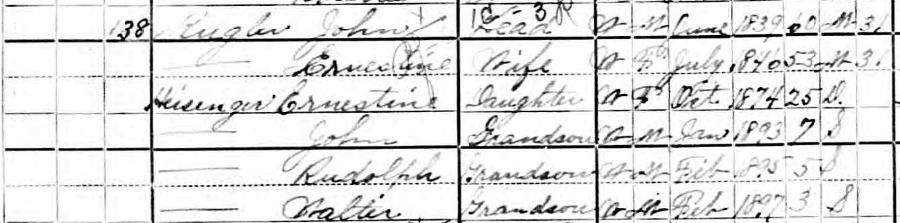 John Kugler Household, 1900 U.S Federal Census, Brooklyn Ward 28, Kings, New York; Roll 1066; Page 7A; Enumeration District 0502, accessed at familysearch.org.
When I began researching the Heisinger side of the family, the earliest record I could locate for Walter was the 1900 U.S. Federal Census, when he was 3 years old living in the household of his grandparents, John and Ernestine Kugler, in Brooklyn, New York. Also in the household were Walter’s mother, recorded as Ernestine Heisinger, and Walters’s two older brothers, John (Jean) and Rudolph. Ernestine Heisinger was recorded as divorced. Locating this record helped explain why Walter never spoke of his father, if they were no longer living together when Walter was so young— but it did not help me to identify his father.
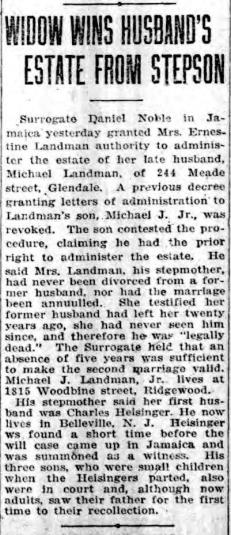 The Brooklyn Standard Union, 19 Dec. 1920, p. 3, accessed at fultonhistory.com.
Tracing the family forward, I discovered that Ernestine (Kugler) Heisinger later remarried a man named Michael Landman. It would be this information that eventually led me to identifying Walter’s father. A newspaper article in The Brooklyn Standard Union on 19 December 1920 reported that Ernestine Landman, widow of Michael Landman, was granted the authority to administer her late husband’s estate after her stepson had contested her right, claiming that she had never divorced her first husband. The article mentioned that Ernestine’s first husband was summoned as a witness in the case, and that it was the first time Walter or his brothers had seen their father since he abandoned the family twenty years earlier. His name: Charles Heisinger. Finally!
With his name, I was able to track down and order the marriage record for Charles Heisinger and Ernestine Kugler from the New York City Department of Health. I discovered they were married in Brooklyn, on 27 March 1892. Luckily, the marriage record contained a wealth of information about both Ernestine and Charles. I learned that Charles’s full name was Karl Frederick Wilhelm Heisinger, that he was 25 years old at his marriage, and that he was born in New York City. Even more exciting, the groom's parents' names on the record enabled me to take the Heisinger line back another generation to Karl and Henrietta Heisinger, who immigrated to New York from Prussia in 1861.
After many years of wondering, I now know where my maiden name came from, and I have a better sense of the trials and tribulations that created the gap in my family’s history. I also can understand why my great-grandfather never spoke of his father. In my journey to find Charles Heisinger, I see how family history findings can both humanize our ancestors and maybe even help heal the pains of the past.