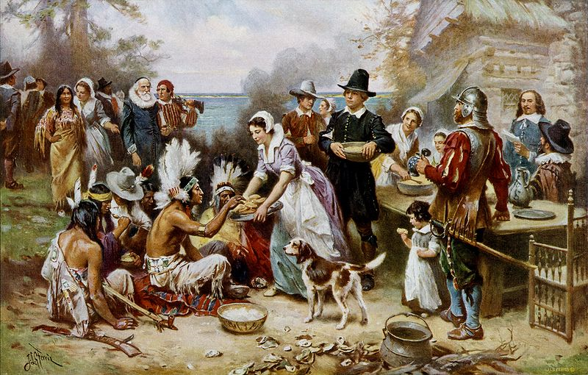
 Jean Leon Gerome Ferris, "The First Thanksgiving, 1621." Courtesy of Wikimedia Commons
A popular image exists of Native Peoples meeting the passengers of the Mayflower as a first contact scenario where the indigenous populations in what would become New England saw Europeans for the first time. This is a romantic myth designed to create warm feelings of a cooperative relationship leading to the first Thanksgiving. In fact, the Native populations in New England had already met European fishermen and traders nearly a century before the Mayflower arrived at Plymouth and their interactions with Europeans made them wary of the newcomers.[1]
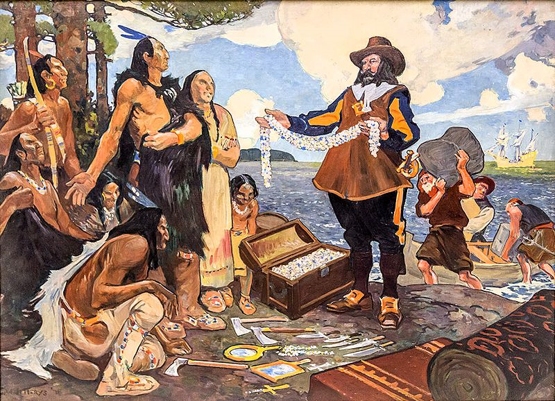 Charles William Jefferys, "Champlain Trading with the Indians." Courtesy of Wikimedia Commons
English and French fishermen were first drawn to the coast of New England for the rich resources of fish. By 1610, historians estimate that Britain alone had about 200 fishing vessels operating in New England and Newfoundland and hundred more were in the region from other European countries.[2] All early accounts by Europeans suggest that the region was thickly settled and defended so well that explorer Samuel de Champlain abandoned attempts to establish a French base on Cape Cod in 1605 and 1606. A similar attempt by the British in Maine in 1608 resulted in a conflict that killed eleven colonists and drove the rest from these shores.[3]
Historians have argued that it was the early contact between Europeans and the Wampanoag that created the environment which allowed English colonists to establish settlements. Early European traders not only brought copper bowls and glassware but their diseases as well. While there had been many smaller epidemics since first contact, beginning about 1616, a new disease spread along the coast for at least three years, and in many cases wiped out entire communities. One theory is that the disease was leptospirosis brought over by infected rats on ships. It is estimated that between 50–90% of the people on the coast were killed before the plague subsided. This left a substantial hole in the landscape that the Pilgrims were able to fill.[4]
Early European traders not only brought copper bowls and glassware but their diseases as well.
Political strife between the Wampanoag and the neighboring Narragansett also contributed to concern among the former. The disease that dramatically reduced the Wampanoag’s population had not hit the Narragansett, who then had a definitive advantage. Owing to this, Massasoit, a sachem of one group of Wampanoag, felt it necessary to build an alliance with the British to help protect against an attack from the Narragansett.[5]
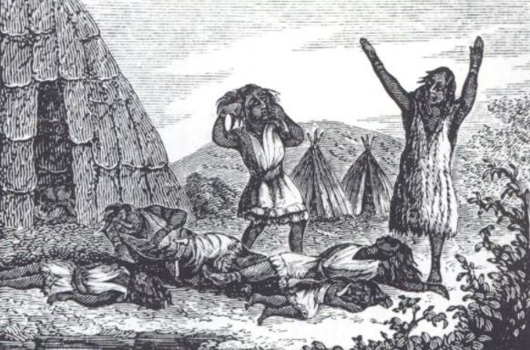 "Indians Lament Death by Disease." Courtesy of the New England Historical Society
The Pilgrims had their own concerns upon their arrival. They had no charter and therefore no legal claim to territory in New England. To get around this, they made a pact of mutual assistance with the Wampanoag. The Pilgrims regarded this alliance as a deed to an unspecified acreage of land which allowed for their legal settlement. The Wampanoag tolerated their settlement at Patuxet out of political necessity. The village had been depopulated and abandoned by the epidemic of the previous years and the Wampanoag needed protection from the Narragansett which the settlers at Plymouth offered to provide. This arrangement led to a “patron-client” relationship, though the Wampanoag were able to retain their formal independence until 1671.[6]
The myth of the first contact between the Wampanoag and the Pilgrims is not entirely false – they did form an alliance. However, it was not one made in the pleasant first contact scene we may imagine from our childhood lessons, but one driven by years of suffering and a need for survival.
Further Reading:
Mark Laskey, The Great Dying: New England’s Coastal Plague, 1616-1619
Charles C. Mann, 1491: New Revelations of the Americas Before Columbus.
John S. Marr and John T. Cathey, New Hypothesis for Cause of Epidemic among Native Americans, New England, 1616–1619
Cristobal Silva, Miraculous Plagues: An Epidemiology of Early New England Narrative
Notes
[1] James Axtell, Natives and Newcomers: The Cultural Origins of North America (New York and Oxford: Oxford University Press, 2001), 16.
[2] Ibid., 79–81.
[3] Charles C. Mann, 1491: New Revelations of the Americas Before Columbus (New York: Vintage Books, 2006), 52.
[4] Francis Jennings, The Invasion of America: Indians, Colonialism, and the Cant of Conquest (Chapel Hill: The University of North Carolina Press), 30.
[5] Mann, 1491: New Revelations of the Americas Before Columbus, 33–39.
[6] Jennings, The Invasion of America: Indians, Colonialism, and the Cant of Conquest, 131.