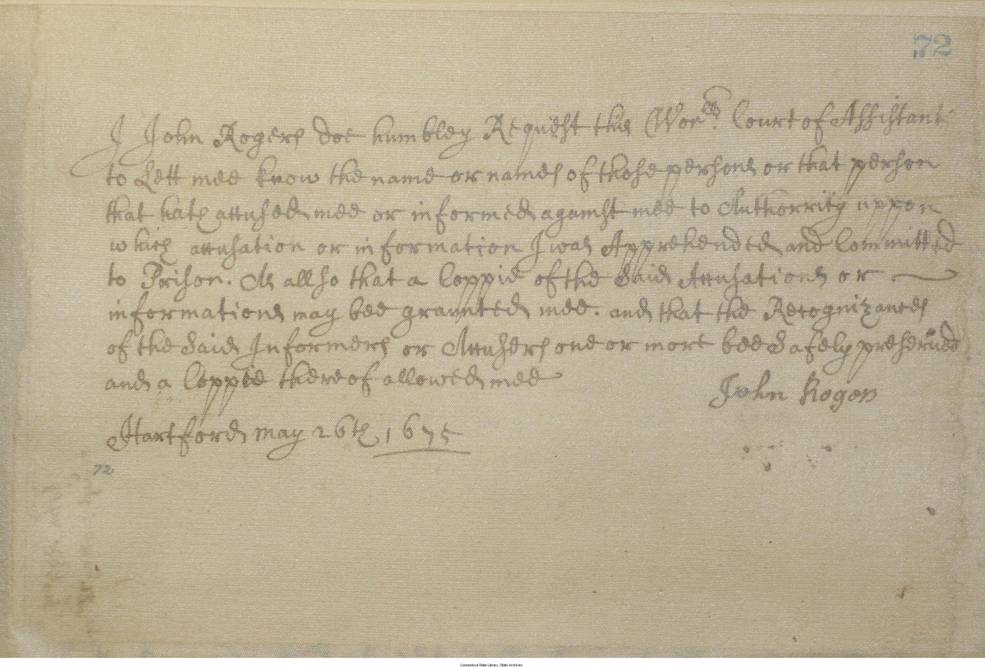
 John Rogers' appeal, 1675. Connecticut State Library, State Archives, RG 000, Samuel Wyllys papers
While attending the FGS conference in Fort Wayne, Indiana, in August, Lynn Martin of Paw Paw, Michigan visited the NEHGS booth in the vendor hall and introduced me to her early immigrants – specifically her Rogers family. John Rogers, Sr. founded his own religion – the Rogerenes, in 1674 – in New London, Connecticut. Today, the only tangible remains of this religion in Connecticut are the neighborhoods of Quaker Hill in Waterford and Quakertown in Ledyard. While sometimes referred to as the Rogerene Quakers, they actually never had any association with the Society of Friends. Instead, their roots come from the Seventh Day Adventists.
The beliefs of the faith share commonalities with many other (at that time) dissenting groups. For instance, they believed in adult baptism like the Baptists. They shared healing by prayer with the Christian Scientists. They also believed in silence during worship like the Quakers. And unlike the Congregational churches who staunchly believed in Sundays being the most holy of days, they shared views on Saturday services with the Seventh Day Adventists. However, they also believed that, after attending church, the day was to be treated like any other day – and they often did their best to draw attention to this belief, antagonizing those who believed otherwise.
[They] also believed that, after attending church, the day was to be treated like any other day – and they often did their best to draw attention to this belief, antagonizing those who believed otherwise.
John Rogers, Sr. broke away from the Seventh Day Adventists, declaring himself a minister and gathering some followers; he would continue his uncompromising ways. Unlike many of the other non-Congregational Church denominations, the Rogerenes were not known for trying to get along or remain out of sight. They were often confrontational, announcing they were working on the Sabbath or flaunting that they were married according to Rogerene beliefs, which were not recognized by either the civil or church authorities. One person during these early years who was often the focus of their confrontations was Gurdon Saltonstall.
During the 1600s, the Rogerenes, or more specifically John Rogers Sr., could often be found before the local magistrate. At one point after Saltonstall became governor of Connecticut, he proclaimed John Rogers Sr. insane. The cell in which Rogers was remanded had the windows blocked out – a punishment for one found to be insane. In response the Rogerenes removed what was blocking the windows. Another time they removed doors from the jail in response to an incarceration. They taunted their Congregational neighbors in other ways, including destruction of the congregation’s church building.
As the centuries progressed, the Rogerenes continued, embracing a manner of pacifism. They would proclaim themselves anti-war and anti-military; they held Peace Conventions. They also were dedicated abolitionists and active in the Underground Railroad.
During the eighteenth century, a couple of groups left the New London area and moved on to New Jersey. One of them settled in Roxbury Township, near Lake Rogerine – which at their arrival in 1700 was known as Mountain Pond. The other group arrived about 1734 and settled on the eastern side of Schooley’s Mountain near what is today Hackettstown. According to Lynn Martin, some of the descendants still live on Schooley’s Mountain to this day; however, various articles indicate the religion is no longer active.
If you are interested in learning more about this group, here are some articles:
- The Rogerenes Leave Their Mark on Connecticut Society
- In 1674 the Connecticut Rogerenes Test the Limits of Religious Freedom
John Rogers’ place in history is also covered in John Warner Barber’s Connecticut Historical Collections, just reprinted by the New England Historic Genealogical Society.
In addition, Gutenberg.org has transcribed a 1904 publication: The Rogerenes: Some Hitherto Unpublished Annals Belonging to the Colonial History of Connecticut, written by John Rogers Bolles and Anna Bolles Williams.