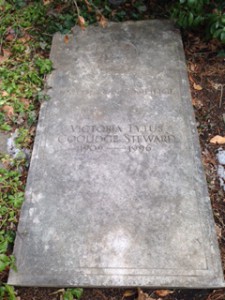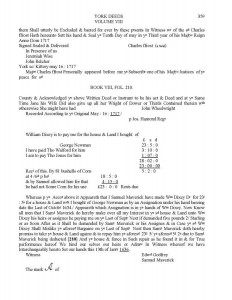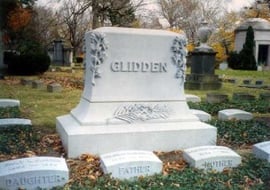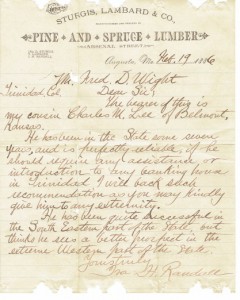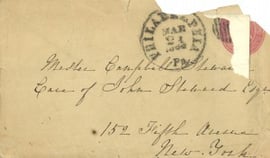
Riffing on something Chris Child wrote about collecting photos of family members in July, I thought I might do something similar with information about family burial plots. Such an exercise leans heavily on Findagrave.com (where some of the images may be found),..
Continue readingWhile working on the Early New England Families Study Project sketch on..
Continue reading →Regina Shober Gray’s diary abounds in telling details and contemporary gossip; in some ways, her views on the marriages (and marriage prospects) of her friends call..
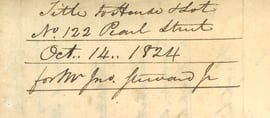
Continue reading →It was a matter of some pride to my grandfather that his great-grandfather John Steward (1777–1854) bought the (downtown) Gracie Mansion[1] when he moved to New York more than two hundred years ago. Perhaps so, as John Steward lived at 1 Pearl Street until he moved far..
Continue reading →One of the most remarkable entries in the Regina Shober Gray diary – a document not short on remarkable entries – is the one where the diarist recounts a vivid..
Continue reading →There is a tendency, I think, to imagine that our ancestors moved around far less than we do, that they were parked in one spot for years at a time – perhaps..
Continue reading →[Editor’s Note: Between June and August of this year, Alicia wrote two series on her research and writing methodologies. In the interest of bringing them together, and sharing them with a fresh audience, they are offered again, with some of the author’s commentary. The..
Continue reading →Every family history researcher hopes diligence and persistence will bring forth enough details of an ancestor’s life to fill out a void on the family tree. There is always hope that serendipity will produce unexpected history gold in..
Continue reading →As it turns out, the envelope in which my great-great-grandmother’s letter to her son was mailed in 1864 (and found in my grandfather’s box of family papers) also contains a story written by my great-grandfather and dated 1 November 1862. His own interpolations are..
Continue reading →When writing your family history, it's important to decide what to omit. This almost sounds like perverse advice, doesn’t it? And yet, when I read a recent New Yorker article on that topic by John McPhee,[1] I realized that omission is an essential part of the process..
Continue reading →