It is just a little over a year since NEHGS President and CEO Brenton Simons came to me with the idea for what became the Early New England Families Study Project. I was immediately interested, not only because it is an important institutional project, but because it..
Continue readingLately, I have been reading Tom Webster’s Godly Clergy in Early Stuart England: The Caroline Puritan Movement, c.1620-1643. Much of this volume is built around Thomas Hooker’s time in Chelmsford, Essex, in the late 1620s. One of my goals is to document in detail and..
Continue reading →As a follow-up to my first post at Vita Brevis, back in early January, I am happy to report that a likely photograph of my..
Continue reading →My winter social schedule was enlivened recently with a talk given by one of my favorite speakers, Peg Baker of Plymouth. She and her husband, Jim Baker, are well known for their vast expertise in all things Pilgrim. Peg is Director Emeritus of The Pilgrim Society in..
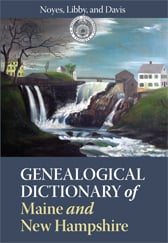
Continue reading →For more than seventy years the Genealogical Dictionary of Maine and New Hampshire – compiled by Charles Thornton Libby, Walter Goodwin Davis, and Sybil Noyes, and published between 1928 and 1938 – has been the first recourse for those looking to trace their..
Continue reading →In his 1693 will, Richard Martyn of Portsmouth, New Hampshire, directed that all the books his third wife “brought with her to my house” be returned to her. Curiosity sent me off on a tangent (it doesn’t take much to distract me) to see if I could identify those books..
Continue reading →NEHGS recently bought a luxuriant “genealogical tree” chart* of Queen Victoria and her descendants, published for the Queen’s Diamond Jubilee in June 1897. The chart, removed from the issue of The Graphic dated 26 June 1897, was at one time in the collection of the..
Continue reading →What to us might seem a rather morbid seventeenth-century tradition was the bestowal of mourning gifts on those who took part in your funeral, such as the coffin bearers, as well as family and friends. Samuel Sewall made a list of thirty funerals at which he was a..
Continue reading →Probate inventories can tell us a lot about the living conditions of our ancestors, but as they are usually difficult to read and interpret, more often than not the little details are skipped by family historians. Nearly everyone records the amount of land in the..
Continue reading →“Write down what you know” is the first step in family history research. For many of us, what we know includes family stories that have been passed down from generation to generation. But sometimes those stories can be misleading – or just plain incorrect. For example,..
Continue reading →