---
title: "The Finest Kind: The Grief and the Glory"
description: Explore the profound connection between grief and glory in Gloucester's fishing community, where loss shapes identity and resilience endures through generations.
image: https://vitabrevis.americanancestors.org/hubfs/Fishermens_Memorial_Gloucester_Mass.png
---
# [Vita Brevis A resource for family history from AmericanAncestors.org](https://vitabrevis.americanancestors.org/)
- [Home](https://vitabrevis.americanancestors.org/)
- [About](https://vitabrevis.americanancestors.org/2014/01/generatio-longa-vita-brevis/)
- [Authors](https://vitabrevis.americanancestors.org/#)
- [Robert Charles Anderson](https://vitabrevis.americanancestors.org/blog/author/randerson)
- [Scott Steward](https://vitabrevis.americanancestors.org/blog/author/ssteward)
- [Alicia Crane Williams](https://vitabrevis.americanancestors.org/blog/author/acwilliams)
- [A-F](https://vitabrevis.americanancestors.org/#)
- [Robert Charles Anderson](https://vitabrevis.americanancestors.org/blog/author/randerson)
- [Jason Amos](https://vitabrevis.americanancestors.org/blog/author/jamos)
- [Emily Baldoni](https://vitabrevis.americanancestors.org/blog/author/ebaldoni)
- [Sally Benny](https://vitabrevis.americanancestors.org/blog/author/sbenny)
- [Nancy Bernard](https://vitabrevis.americanancestors.org/blog/author/nbernard)
- [Lynn Betlock](https://vitabrevis.americanancestors.org/blog/author/lbetlock)
- [Kristin Britanik](https://vitabrevis.americanancestors.org/blog/author/kbritanik)
- [Laura Brown](https://vitabrevis.americanancestors.org/blog/author/lbrown)
- [Stephanie Call](https://vitabrevis.americanancestors.org/blog/author/scall)
- [Christopher C. Child](https://vitabrevis.americanancestors.org/blog/author/cchild)
- [Ralph Crandall](https://vitabrevis.americanancestors.org/blog/author/rcrandall)
- [Lael Dalal](https://vitabrevis.americanancestors.org/blog/author/ldalal)
- [Marie Daly](https://vitabrevis.americanancestors.org/blog/author/mdaly)
- [David Dearborn](https://vitabrevis.americanancestors.org/blog/author/ddearborn)
- [Sheilagh Doerfler](http://http://vitabrevis.americanancestors.org/blog/author/sdoerfler)
- Tom Dreyer
- [Katrina Fahy](https://vitabrevis.americanancestors.org/blog/author/kfahy)
- [Lindsay Fulton](https://vitabrevis.americanancestors.org/blog/author/lfulton)
- [G-M](https://vitabrevis.americanancestors.org/#)
- [Zachary Garceau](http://http://vitabrevis.americanancestors.org/blog/author/zgarceau)
- [Judi Garner](https://vitabrevis.americanancestors.org/blog/author/jgarner)
- [Andy Hanson-Dvoracek](https://vitabrevis.americanancestors.org/blog/author/andyhd)
- [Helen Herzer](https://vitabrevis.americanancestors.org/blog/author/hherzer)
- [Henry Hoff](https://vitabrevis.americanancestors.org/blog/author/hhoff)
- [Alice Kane](https://vitabrevis.americanancestors.org/blog/author/akane/)
- [Johnna Kaplan](https://vitabrevis.americanancestors.org/blog/author/jkaplan)
- [Andrew Krea](https://vitabrevis.americanancestors.org/blog/author/akrea)
- [David Allen Lambert](https://vitabrevis.americanancestors.org/blog/author/dalambert/)
- [Ann Lawthers](https://vitabrevis.americanancestors.org/blog/author/alawthers)
- [Don LeClair](https://vitabrevis.americanancestors.org/blog/author/dleclair)
- [Christopher Lee](https://vitabrevis.americanancestors.org/blog/author/cclee)
- [Katherine Lonergan](http://http://vitabrevis.americanancestors.org/blog/author/klonergan)
- [Judith Lucey](https://vitabrevis.americanancestors.org/blog/author/jlucey)
- [Jean Maguire](https://vitabrevis.americanancestors.org/blog/author/jmaguire)
- [Rhonda McClure](https://vitabrevis.americanancestors.org/blog/author/rmcclure)
- [Anne Meringolo](https://vitabrevis.americanancestors.org/blog/author/ameringolo)
- [P-Z](https://vitabrevis.americanancestors.org/#)
- [Eileen Pironti](https://vitabrevis.americanancestors.org/blog/author/epironti)
- [Molly Rogers](https://vitabrevis.americanancestors.org/blog/author/mrogers)
- [Deb Rossi](https://vitabrevis.americanancestors.org/blog/author/drossi)
- [Timothy Salls](https://vitabrevis.americanancestors.org/blog/author/tsalls)
- [Meaghan E. H. Siekman](https://vitabrevis.americanancestors.org/blog/author/msiekman)
- [D. Brenton Simons](https://vitabrevis.americanancestors.org/blog/author/dbsimons)
- [Susan Sloan](https://vitabrevis.americanancestors.org/blog/author/ssloan)
- [Scott Steward](https://vitabrevis.americanancestors.org/blog/author/ssteward)
- [Penny Stratton](https://vitabrevis.americanancestors.org/blog/author/pstratton)
- [Sam Sturgis](https://vitabrevis.americanancestors.org/blog/author/ssturgis)
- [Helen Schatvet Ullmann](https://vitabrevis.americanancestors.org/blog/author/hsullmann)
- [Roger Thompson](https://vitabrevis.americanancestors.org/blog/author/rthompson)
- [Leah Walczak](https://vitabrevis.americanancestors.org/blog/author/lwalczak/)
- [Leslie A. Weston](https://vitabrevis.americanancestors.org/blog/author/lweston)
- [Alicia Crane Williams](https://vitabrevis.americanancestors.org/blog/author/acwilliams)
- [Ryan Woods](https://vitabrevis.americanancestors.org/blog/author/rwoods)
- [Subscribe](https://vitabrevis.americanancestors.org/blog/subscribe/)
- [AmericanAncestors.org](https://americanancestors.org)
This is a search field with an auto-suggest feature attached.
- There are no suggestions because the search field is empty.
# The Finest Kind: The Grief and the Glory
[July 27, 2026](https://vitabrevis.americanancestors.org/the-finest-kind-the-grief-and-the-glory) [Massachusetts](https://vitabrevis.americanancestors.org/tag/massachusetts), [Maritime history](https://vitabrevis.americanancestors.org/tag/maritime-history) [Susan Donnelly](https://vitabrevis.americanancestors.org/author/sdonnelly)
*“There is a superlative that we use for those that go to sea out of this port, the ones that we hold up high, the ones that we honor, the ones whose legacy we treasure…. We call those people the finest kind.”* – Massachusetts Senator Bruce E. Tarr.
It happens on occasion, or maybe more, when our ancestral quests reveal signs of collective loss. A single headstone bears several names whose death dates cluster closely. In the same cemetery, nearby stones reveal a similar pattern, where the intervals between dates are measured in days rather than years. A disaster announces itself.
Catastrophes force a shared rupture within a community, leaving their mark across the cemetery landscape of a single town. And in the wake of these tragedies, those who go on living are bound by a common wound when the memory of loss becomes a formative part of communal identity. Whereas war and disease show themselves in recognizable trends across eras, natural disasters often gather their losses within a single date and location. Yet less visible are the cumulative tragedies of occupation and labor, where loss unfolds across generations of an inherited trade.
Many American towns grew up around a specific sector of work where the day’s wage stood at the center of life. The established flagship location of a company transforms the character of a place. Other locales developed more bluntly, their industries immediately forming from the offerings of the natural environment. The environment provided the opportunity, and the opportunity inspired an industry, cultivating a community and a tradition. In these places all over the world, the identity of an individual is indistinguishable from the identity of the town.
Gloucester sits on the northeastern tip of Massachusetts, where commercial fishing is a hereditary duty. It was in 1623 that a handful of British fishermen began a fishing business that was among the first commercial enterprises in the New World. Cod was America’s first currency and fishing has been the heartbeat of Gloucester for over 400 years.1 The descendants preserved the culture of their immigrant forebears, whose skills and knowledge helped build the region. Each day, men and women leave port and set their course toward the open waters to bring its harvest ashore. In doing so, they accept a constant reality: that the same work sustaining their community may also be the voyage from which they do not return.2 Thus is the inherited and enduring truth that its grief has always been bound to its glory.
---
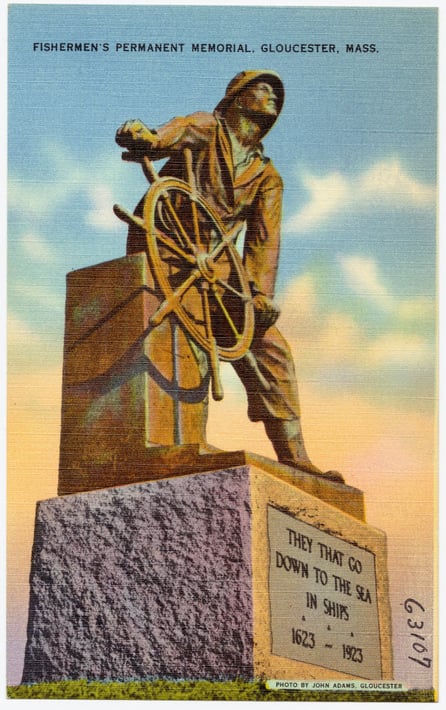
*Fishermen's Memorial, Gloucester MA *
The life of the commercial fisherman is unglamorous and unforgiving. It requires resilience and depends on an intimate knowledge of the water. Fishermen come to know the sea much as others learn the streets of a town. They read its depths and currents, the shifting character of the bottom, the landmarks that guide navigation, the seasonal movements of fish, and the subtle changes in weather that signal a gray space that fuses risk with opportunity. Fishermen must also be mechanics and craftsmen, able to repair engines, mend nets, and keep their vessels working far from safe harbor. It is acknowledged and expected that all those onboard perform the task at hand with competence and resolve, even when the outcome is uncertain.3
Technology has eased certain burdens, but the work of a fisherman remains dangerous and time-consuming. Days often begin long before sunrise and active labor can stretch 15 hours or more, commanding endurance and cooperation from every hand. In winter, boats push into harsh winds and freezing seas, rolling and pitching as crews endure the elements.
Regaled are the stories of survival that don’t make the headlines. These near-death enterprises follow long journeys home, where the brief stay ashore may last only until the day after the first home-cooked meal in weeks. These are not fair-weather sailors. They work because the work must be done. The calling is sustained by commitment of heart.4
Fishing operations are frequently family ventures in which knowledge, techniques, and equipment pass from parent to child. Families often take part in every aspect of the work, from preparing the vessel to processing and selling the catch brought ashore. Fishing communities share an ancestry rooted not only in a bloodline, but in the kinship created by generations who were shaped by the same work, waters, and risks. The fishing community is all family. The loss of one person is felt by everyone. Few traditions embody this more fully.
On Stacy Boulevard stands the “Fisherman’s Memorial” or “Man at the Wheel,” a statue of a helmsman in slicker, boots, and hat dedicated to all Gloucester fishermen who lost their lives in pursuit of their traditional obligation. “This is the greatest fishing port in the history of the Western Hemisphere, also the one with the most tragedies.”5
In the early morning hours of January 30, 2026, the fishing vessel (F/V) Lily Jean was approximately 25 miles off the coast of Cape Ann when its emergency position-indicating radio beacon was activated. The signal was received during one of the harshest days in one of the most difficult winters in recent memory, as cold temperatures and rough conditions prevailed across the North Atlantic. The vessel is believed to have been returning to port with a full catch before she vanished with seven crew members aboard. The U.S. Coast Guard launched a search that continued for roughly twenty-four hours and covered more than 1,000 square miles of ocean before they made the difficult decision to suspend rescue efforts.6
It is a maritime tragedy in which both vessel and crew were lost at sea. The captain, who had been fishing for more than three decades, descends from multiple generations of fishermen. His surname was of Sicilian origin and reflects the sprawling roots of a large tree of master fishermen who came to Massachusetts from the shores of Agrigento, Messina, Syracuse, Augusta, and Sciacca.7
*“If you sail once out of this harbor or a thousand times, you are a Gloucester fisherman. So, they’ll forever be Gloucester fishermen.”* – Al Cottone, executive director of the Gloucester Fisheries Commission.8
“Lost at Sea” is not only a phrase, but a recurring fate in coastal communities where the hazards of inherited labor are accepted as part of life. When tracing ancestors whose lives were bound to the water, the surviving evidence is often sparse, varied, and difficult to locate.
The City of Gloucester maintains a publicly accessible, printable register of individuals lost at sea as a resource for researching commercial fishing ancestors. As noted by the compilers, the list is incomplete; the recovery of the names of all Gloucester fishermen lost at sea is unlikely, given the fragmentary nature of historical records and the number of maritime losses. The site invites the public to submit corrections, additions, or inquiries through the city’s archives committee. This register can be accessed here: [https://www.gloucester-ma.gov/74/Lost-at-Sea](https://www.gloucester-ma.gov/74/Lost-at-Se).
Extending more than 800 pages, the register is arranged alphabetically. Entries record the name of the deceased, when known; age; date of disappearance or recovery; familial information, including marital status and children; vessel name; and known circumstances surrounding the loss. An “F” designation identifies individuals known to have been engaged in the fishing trade. Of particular scholarly value are the source citations included within the entries. At present, the register documents known losses from the 17th century through 2009.
Few callings demand the toughness and resilience asked of fishermen and their families. The work itself remains physically dangerous, while its economic viability grows more uncertain. Those who stand on land carry a burden to go on after loss and to weigh the risks of continuing with an ancestral purpose to choose the water. They are a rare breed of people, integral to the history of New England and Massachusetts and essential to the economic history of North America. The grief persists. The glory endures. They are the finest kind.
[ ](https://vitabrevis.americanancestors.org/hs/cta/wi/redirect?encryptedPayload=AVxigLJz9ngzK81BzK%2FMtSN6OAc8bqNmwyEawuu5GwB%2FRrU5tFrowh4Vl5S1pSHy8c67ktENXoGg6d7o0xcW1Cgt3rMpfB1aqfTmUOb9qirAybYFiCSsApE2Yq1LaS6cN%2FwMkJSrwF6jERy6bJCzJbxdFbUYXUBfEpy33KvT1Tzlj3NeZApE4EB%2FwxbgYqzpFz4oV6WGUUbeqkssw0FvZ5qUVcd9AQQBVZptlujuAhq9i6h6mqF2PGfCrI7KrTJ7nW79xIj1UYyJkDzHfe9YH%2BMp3DOqITwU%2FuLjKgxnAKJz%2BeEWv9syUEG67IN7OYtLZ2E9MxtzVEAquCXTGPE%3D&webInteractiveContentId=217911091832&portalId=4306738)
Sources
[1] Joseph Garland, *Down to the Sea: The Fishing Schooners of Gloucester *(David R. Godine, 1983)*, *3; Daniel Vickers, *Farmers and Fishermen: Two Centuries of Work in Essex County, Massachusetts 1630-1850* (University of North Carolina Press,1994) 85.
[2] Joseph Garland, *Down to the Sea*, 105.
[3] Vickers, *Farmers and Fishermen*, 91; Shari L. Dann, Ph.D, “The Life of the Lakes: A Guide to the Great Lakes Fishery”, (Department of Fisheries & Wildlife, Michigan State University, 1994), *NOAA*, repository.library.noaa.gov.
[4] Joseph Garland, *Down to the Sea,* xi; Jeremiah V. Murphy, “Ancient Boats, Outdated Methods Killing Gloucester Fishing Fleet”, *The Boston Globe *(Boston, Mass.) May 5, 1963, p.68.
[5] Charles Hillinger, “Gloucester: Massachusetts’ shrine to fishermen”, *The Berkshire Eagle *(Pittsfield, Mass.), Apr. 28, 1991, p.60 in Newspapers.com [quote by Joseph Garland.]
[6] “Coast Guard suspends search for crew of fishing boat Lily Jean that sank off Gloucester”, *CBS News*, Feb. 1, 2026, cbsnews.com.
[7] Tonya Alanez and Jeremiah Manion, “Since 2001, nearly 50 lives lost at sea off New England”,* The Boston Globe *(Boston, Mass.) Feb 1, 2026, p.B5; Seth Jacobson, “Is this the coldest winter of your life in Massachusetts? That depends on your age”, * Telegram & Gazette *(Worcester, Mass.), Feb. 18, 2026, at telegram.com; John R. Ellement, Shannon Larson, and Chris Serres, “Gloucester braces as search for boat goes on”, *The Boston Globe* (Boston, Mass.), Jan 31, 2026, p.A1, A10; United States Coast Guard, “Coast Guard Northeast District Investigating Cause of F/V Lily Jean Incident” Feb. 2, 2026, *United States Coast Guard News*, news.uscg.mil; [For privacy reasons, the genealogy of the captain and other crew members was not researched for this article. The captain’s surname was queried in Massachusetts naturalization declarations only to identify origin of birth associated with the surname in Sicily. The author makes no claim regarding the birthplace of the ancestors of the captain of the (f/v) Lily Jean]; Jim Hooper, “Portraits of a Working Waterfront”, photographs, Gloucester, Mass., Cape Ann Museum, capeannmuseum.org;
[8] “Update on missing fishing vessel, Lily Jean”, posted Feb 2, 2026, by WCVB Channel 5 Boston, YouTube, 20 min., 55 sec. YouTube.com.
### Share this:
- [mailto:?body=https://vitabrevis.americanancestors.org/the-finest-kind-the-grief-and-the-glory](mailto:?body=https://vitabrevis.americanancestors.org/the-finest-kind-the-grief-and-the-glory)
-
-
- More
-
-
## About Susan Donnelly
Susan is a native New Englander and second generation American from a large extended family of artists. She spent two years with the Research Services team, working on several large projects, before joining Newbury Street Press. Prior to NEHGS, Susan was the director and auction coordinator with a premier antique gallery in Boston for two decades and an archival volunteer with the Hingham Historical Society. She received her B.A. in English Literature from Simmons College and holds a Professional Certificate in Genealogy from Boston University. Her research interests include Colonial America, royal ancestry, westward expansion, and U.S. migration trails. Susan is a photographer and potter and collects mid-century modern art.[View all posts by Susan Donnelly →](https://vitabrevis.americanancestors.org/author/sdonnelly)
[Stories of Black Life in Eighteenth-Century Boston →](https://vitabrevis.americanancestors.org/scipio-fayerweather-and-cuffee)
This is a search field with an auto-suggest feature attached.
- There are no suggestions because the search field is empty.
### Recent Posts
[The Finest Kind: The Grief and the Glory](https://vitabrevis.americanancestors.org/the-finest-kind-the-grief-and-the-glory)
[Stories of Black Life in Eighteenth-Century Boston](https://vitabrevis.americanancestors.org/scipio-fayerweather-and-cuffee)
[How Bronzed Baby Shoes Became More Than Just a Mother’s Treasure!](https://vitabrevis.americanancestors.org/bronzed-baby-shoes)
[Charles Bulfinch – A Father of Federal Style Architecture](https://vitabrevis.americanancestors.org/charles-bulfinch)
[Sailor Bill and His Forgotten Wife](https://vitabrevis.americanancestors.org/sailor-bill-and-his-forgotten-wife)
### Archives
- [October 2014 (27)](https://vitabrevis.americanancestors.org/archive/2014/10)
- [December 2015 (24)](https://vitabrevis.americanancestors.org/archive/2015/12)
- [July 2020 (24)](https://vitabrevis.americanancestors.org/archive/2020/07)
- [April 2014 (23)](https://vitabrevis.americanancestors.org/archive/2014/04)
- [July 2014 (23)](https://vitabrevis.americanancestors.org/archive/2014/07)
- [December 2014 (23)](https://vitabrevis.americanancestors.org/archive/2014/12)
- [July 2015 (23)](https://vitabrevis.americanancestors.org/archive/2015/07)
- [March 2017 (23)](https://vitabrevis.americanancestors.org/archive/2017/03)
- [May 2017 (23)](https://vitabrevis.americanancestors.org/archive/2017/05)
- [August 2017 (23)](https://vitabrevis.americanancestors.org/archive/2017/08)
- [January 2018 (23)](https://vitabrevis.americanancestors.org/archive/2018/01)
- [March 2014 (22)](https://vitabrevis.americanancestors.org/archive/2014/03)
- [August 2014 (22)](https://vitabrevis.americanancestors.org/archive/2014/08)
- [April 2015 (22)](https://vitabrevis.americanancestors.org/archive/2015/04)
- [September 2015 (22)](https://vitabrevis.americanancestors.org/archive/2015/09)
- [October 2015 (22)](https://vitabrevis.americanancestors.org/archive/2015/10)
- [March 2016 (22)](https://vitabrevis.americanancestors.org/archive/2016/03)
- [June 2016 (22)](https://vitabrevis.americanancestors.org/archive/2016/06)
- [August 2016 (22)](https://vitabrevis.americanancestors.org/archive/2016/08)
- [September 2016 (22)](https://vitabrevis.americanancestors.org/archive/2016/09)
- [November 2016 (22)](https://vitabrevis.americanancestors.org/archive/2016/11)
- [December 2016 (22)](https://vitabrevis.americanancestors.org/archive/2016/12)
- [January 2017 (22)](https://vitabrevis.americanancestors.org/archive/2017/01)
- [June 2017 (22)](https://vitabrevis.americanancestors.org/archive/2017/06)
- [November 2017 (22)](https://vitabrevis.americanancestors.org/archive/2017/11)
### Categories
- [Family stories (1261)](https://vitabrevis.americanancestors.org/tag/family-stories)
- [American History (1138)](https://vitabrevis.americanancestors.org/tag/american-history)
- [Critical Analysis (1126)](https://vitabrevis.americanancestors.org/tag/critical-analysis)
- [Research Methods (881)](https://vitabrevis.americanancestors.org/tag/research-methods)
- [Brick Walls (674)](https://vitabrevis.americanancestors.org/tag/brick-walls)
- [Object Lessons (617)](https://vitabrevis.americanancestors.org/tag/object-lessons)
- [Spotlight (617)](https://vitabrevis.americanancestors.org/tag/spotlight)
- [Genealogical Writing (554)](https://vitabrevis.americanancestors.org/tag/genealogical-writing)
- [Research tips (510)](https://vitabrevis.americanancestors.org/tag/research-tips)
- [Serendipity (479)](https://vitabrevis.americanancestors.org/tag/serendipity)
- [Road Trips (393)](https://vitabrevis.americanancestors.org/tag/road-trips)
### Recent Posts
[The Finest Kind: The Grief and the Glory](https://vitabrevis.americanancestors.org/the-finest-kind-the-grief-and-the-glory)
[Stories of Black Life in Eighteenth-Century Boston](https://vitabrevis.americanancestors.org/scipio-fayerweather-and-cuffee)
[How Bronzed Baby Shoes Became More Than Just a Mother’s Treasure!](https://vitabrevis.americanancestors.org/bronzed-baby-shoes)
[Charles Bulfinch – A Father of Federal Style Architecture](https://vitabrevis.americanancestors.org/charles-bulfinch)
[Sailor Bill and His Forgotten Wife](https://vitabrevis.americanancestors.org/sailor-bill-and-his-forgotten-wife)
### Meta
- [Log in](https://vita-brevis.org/wp-login.php)
- [Entries RSS](https://vita-brevis.org/feed/)
- [Comments RSS](https://vita-brevis.org/comments/feed/)
- [WordPress.org](https://wordpress.org/)
### Subscribe to Blog via Email
Enter your email address to subscribe to this blog and receive notifications of new posts by email.
### Archives
- [October 2014 (27)](https://vitabrevis.americanancestors.org/archive/2014/10)
- [December 2015 (24)](https://vitabrevis.americanancestors.org/archive/2015/12)
- [July 2020 (24)](https://vitabrevis.americanancestors.org/archive/2020/07)
- [April 2014 (23)](https://vitabrevis.americanancestors.org/archive/2014/04)
- [July 2014 (23)](https://vitabrevis.americanancestors.org/archive/2014/07)
- [December 2014 (23)](https://vitabrevis.americanancestors.org/archive/2014/12)
- [July 2015 (23)](https://vitabrevis.americanancestors.org/archive/2015/07)
- [March 2017 (23)](https://vitabrevis.americanancestors.org/archive/2017/03)
- [May 2017 (23)](https://vitabrevis.americanancestors.org/archive/2017/05)
- [August 2017 (23)](https://vitabrevis.americanancestors.org/archive/2017/08)
- [January 2018 (23)](https://vitabrevis.americanancestors.org/archive/2018/01)
- [March 2014 (22)](https://vitabrevis.americanancestors.org/archive/2014/03)
- [August 2014 (22)](https://vitabrevis.americanancestors.org/archive/2014/08)
- [April 2015 (22)](https://vitabrevis.americanancestors.org/archive/2015/04)
- [September 2015 (22)](https://vitabrevis.americanancestors.org/archive/2015/09)
- [October 2015 (22)](https://vitabrevis.americanancestors.org/archive/2015/10)
- [March 2016 (22)](https://vitabrevis.americanancestors.org/archive/2016/03)
- [June 2016 (22)](https://vitabrevis.americanancestors.org/archive/2016/06)
- [August 2016 (22)](https://vitabrevis.americanancestors.org/archive/2016/08)
- [September 2016 (22)](https://vitabrevis.americanancestors.org/archive/2016/09)
- [November 2016 (22)](https://vitabrevis.americanancestors.org/archive/2016/11)
- [December 2016 (22)](https://vitabrevis.americanancestors.org/archive/2016/12)
- [January 2017 (22)](https://vitabrevis.americanancestors.org/archive/2017/01)
- [June 2017 (22)](https://vitabrevis.americanancestors.org/archive/2017/06)
- [November 2017 (22)](https://vitabrevis.americanancestors.org/archive/2017/11)